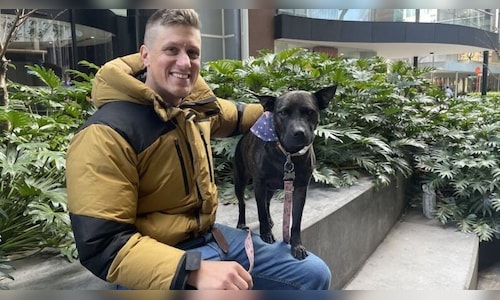
With the assistance of scientists, Conyngham began working on a personalized mRNA vaccine designed specifically for Rosie’s condition.
On X, Sam Altman, the CEO of OpenAI, shared his thoughts on “the coolest meeting” he had this week with Conyngham, who successfully used ChatGPT and other large language models (LLMs) to devise a personalized mRNA vaccine protocol for his dog.
The coolest meeting I had this week was with Paul, who used ChatGPT and other LLMs to create an mRNA vaccine protocol to save his dog Rosie. It is an amazing story.
“The chatbots empowered me as an individual to act with the power of a research institute – planning, education,… https://t.co/akgD2Wz7d0— Sam Altman (@sama) March 27, 2026
Describing it as an ‘amazing story,’ Altman quoted Conyngham’s words on how chatbots enabled him to operate “with the power of a research institute,” managing tasks ranging from planning and education to compliance, troubleshooting, and even scientific design.
“The chatbots empowered me as an individual to act with the power of a research institute… converting genomic data to a vaccine prescription and designing the treatment protocol around it,” said Conyngham, emphasizing that human involvement played a crucial role at every stage, asserting that “the combination is what made it possible.”
According to Altman, the experience sparked an immediate business idea. “It got me thinking – this should be a company,” he noted. “Also, Paul is an extraordinary guy. This should be easy to do, but it is not yet.”
How Conyngham created the vaccine using ChatGPT
Rosie had a mast cell tumour (MCT) on her leg, approximately the size of a tennis ball. MCTs represent the most common type of skin cancer in dogs, and veterinarians predicted she had only a few months left to live.
Conyngham stated that they took Rosie’s tumour, sequenced its DNA, and converted it from tissue to data. He collaborated with Martin Smith, a computational biologist from the University of New South Wales, to address Rosie’s cancer.
Initially, Smith believed that studying the entire genome of the dog would be too challenging due to its complexity.
However, Paul demonstrated that AI tools could conduct the intricate analysis and assist in identifying a solution.
They utilized ChatGPT to discover unique markers on Rosie’s tumour known as neoantigens, and employed AlphaFold to determine the protein shapes of the tumour. Armed with this information, they crafted a custom mRNA vaccine specifically tailored for Rosie’s cancer.
“We took her tumour, sequenced the DNA, converted it from tissue to data, and then searched for the issue in her DNA to develop a cure based on that,” he explained.
Steven Hsesheng Lin, a physician-scientist and radiation oncologist at the MD Anderson Cancer Centre, commented, “What’s engaging about this, what’s so interesting, is that [Conyngham] utilized ChatGPT to identify the sequence and generate the RNA vaccine, allowing for a quick generation and injection.”
AI not only facilitated the creation of Rosie’s custom vaccine but also mapped out her entire treatment strategy. It detailed how to integrate the vaccine with other medications, when to administer each dose, and how to ensure the treatment was both safe and effective.
(Edited by : Sudarsanan Mani)