A single bench of Justice Jitendra Jain, in a ruling delivered on Tuesday, also urged passengers not to jeopardize their safety by attempting to board or alight from moving trains.
The court mandated compensation of ₹ 80,000 to a man who sustained injuries while trying to disembark from a moving train at the Jalgaon railway station nearly ten years ago.
It observed that local trains typically feature a display board or announcement indicating the stations where they will not stop.
“However, such a display board or announcement is absent in long-distance trains on the platforms. Long-distance trains are often utilized by passengers for shorter journeys between railway stations,” the HC stated.
When there are no announcements specifying the stations at which a train will not halt, passengers cannot be held at fault for attempting to board or alight at a station where the train doesn’t stop, the court explained.
Passengers should refrain from attempting to get on or off a moving train and are advised to wait until the train comes to a stop at the next station, even if it means paying a fine, the bench advised.
“I acknowledge that in such moments, a person may take risks that could jeopardize their life, but that’s precisely when one’s mental state is put to the test. This is vital for the greater good of the passengers’ families,” Justice Jain remarked.
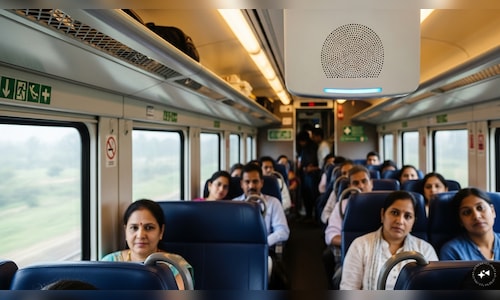
“The railway authorities should implement a public announcement system, similar to that in Vande Bharat trains, across all trains to help mitigate such incidents,” the court noted.
This statement was made in response to an appeal submitted by Rohidas Kumavat, contesting a January 2018 ruling from the Railway Claims Tribunal that denied his compensation claim on the basis that his injury was not a result of an unforeseen incident but rather self-inflicted.
As outlined in the plea, Kumavat was traveling on the Guwahati Express from Manmad to Jalgaon. As the train approached Jalgaon station, he lost his grip due to the crowd and fell from the train, injuring his head and legs.
The tribunal, in dismissing Kumavat’s compensation request, concluded that he fell because he was seated near the door and attempted to disembark as the train neared Jalgaon, believing it would not stop there.
The high court, in its order, remarked that Kumavat was a bona fide passenger who boarded the train with the expectation that it would halt at Jalgaon, considering it a significant location in Maharashtra.
“Nonetheless, realizing that the train did not stop at Jalgaon, if a person attempts to exit a moving train, it is only natural that injuries could occur,” the court stated.
The applicant (Kumavat) had the option to wait until the next station to disembark, but at that moment, panic can cause a person to act without the intent of self-injury, the ruling noted.
“In such situations, no one would voluntarily inflict harm upon themselves, and it’s possible in some cases they could escape injury,” the court added.
The bench awarded a compensation of ₹ 80,000 to Kumavat, which the railway authorities are to pay within 12 weeks.
(Edited by : Sudarsanan Mani)