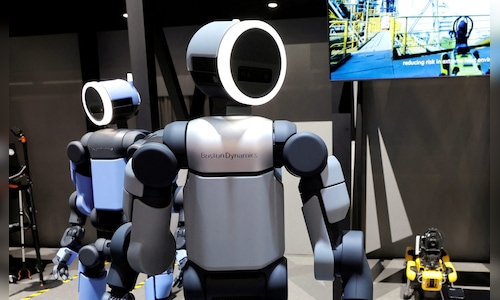
The move to form a robotics-focused unit comes amid a surge of announcements and activities at CES related to humanoid robots. At the expansive Las Vegas trade show, various companies showcased robots capable of assisting in tasks like car manufacturing, cleaning restrooms, and playing poker—albeit slowly.
This is the first report by Reuters regarding the launch of Arm’s Physical AI unit and its reorganization. Arm will now pursue three primary business lines: Cloud and AI, Edge—which encompasses mobile devices and PC offerings—and Physical AI, which will integrate its automotive operations.
Also read: Samsung’s rolling Ballie robot indefinitely shelved after delays
Robots and automobiles are central to physical AI, sharing a broad spectrum of existing sensor technologies and other hardware. Automotive firms, including Tesla, are developing robots to automate tasks within warehouses and factories.
Based in the UK, Arm does not manufacture chips directly but provides the fundamental technology that powers the majority of the world’s smartphones and a growing array of devices such as laptops and data center chips. The company generates revenue through licensing fees and royalties from uses of its designs.
Arm’s heightened emphasis on Physical AI is a key part of a broader strategy to expand its business. Since CEO Rene Haas assumed leadership nearly four years ago, Arm has discovered avenues to increase prices for its latest technologies and is contemplating its own complete chip design.
Arm executives view robotics as a market with significant long-term growth opportunities. Drew Henry, the head of the new unit, informed Reuters that physical AI solutions could “fundamentally enhance labor, free up extra time,” and potentially exert a substantial influence on GDP. This division plans to recruit staff focused on robotics, according to Arm Chief Marketing Officer Ami Badani.
Also read: X responds to MeitY over sexually explicit content generated by Grok
The company merged its automotive and robotics divisions into a single unit, as customer needs surrounding factors like power efficiency, safety, and reliability are alike, Badani explained. Many automakers are venturing into humanoid robotics as well.
When inquired about customer engagement, Henry stated, “We work with everyone.” Arm’s chips are utilized by numerous automakers globally, and by robotics firms such as Boston Dynamics, owned by Hyundai.
The two companies recently introduced a production-ready Atlas humanoid robot, which the Korean manufacturer plans to deploy in U.S. factories by 2028.
Year of the robot at CES
Interest in humanoid robots has surged as companies across both the tech and auto industries regard human-like machines as the next frontier in AI and automation.
Tesla CEO Elon Musk has characterized the company’s humanoid robot initiative, Optimus, as crucial to its future. Musk believes these robots could eventually outpace its vehicle business and unlock significant economic value by tackling tasks humans prefer to avoid.
This year, CES has prominently featured robotics. Reuters noted many companies showcasing humanoid robots in the vast halls of the convention center, where they danced, played ping-pong, and performed repetitive sorting tasks.
Many of the machines exhibited at CES incorporate forms of artificial intelligence, enhancing their functionality.
“(But) the real investment and progress is realized when they merge the machining with the level of AI to boost precision, enhance productivity, or alter production methods,” said C.J. Finn, U.S. automotive industry leader for PwC, to Reuters.
Boston Dynamics CEO Robert Playter commented to Reuters that there is currently “a bit of hype surrounding (robotic) humanoids.” However, he noted that his firm has successfully deployed “thousands of quadruped robots into the market and turned a profit.”
Driving technology company Mobileye, partially owned by Intel, announced plans to acquire robotics firm Mentee for $900 million to integrate its product offerings.
World AI leader Nvidia revealed a tool named Alpamayo alongside other physical AI products aimed at powering the next generation of autonomous vehicles.