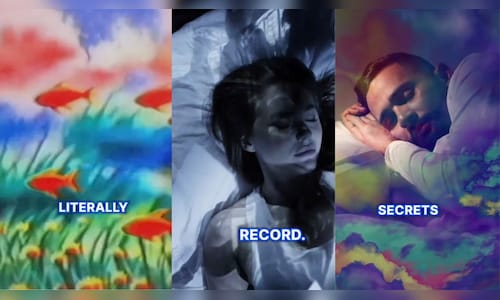
Tech enthusiasts are now creating DIY dream recorders at home. Though these handmade versions may not be flawless, they offer a glimpse into the future of dream research.
What is a Dream Recorder?
A Dream Recorder is a bedside device that captures your dreams while you sleep and allows you to revisit them like a brief film, presenting your dreams as clear, vivid visuals.
The Dream Recorder operates quietly without disrupting your sleep. It functions independently of apps and notifications, providing only a soft glow in the dark. The device includes seven slots for each day of the week, enabling it to store a week’s worth of dreams for later playback.
Introducing Dream Recorder — the magical bedside open-source device that plays your dreams back as cinematic reels.
Build your own pic.twitter.com/ztfACdrEFD— MODEM (@modem_works) June 17, 2025
How does Dream Recorder work?
The device records your dreams in a straightforward manner. While you sleep, it monitors your brain using EEG (sensors on your head) or fMRI (brain scanner) to interpret your brain signals. Upon waking, you verbalize your dream, and the device transforms your description into a visual “dreamscape.”
The outcome is not a flawless film but instead blurry, hazy, and surreal, much like real dreams.
A DIY device turns your dreams into videos using AI. The Dream Recorder lets you describe your dreams out loud.
The Dream Recorder is “a portal to your subconscious” that captures your elusive dreams and “plays them back as vivid, cinematic reels,” according to its website. pic.twitter.com/tKwTIGlfIH— Rhema News (@rhemanewsplus) July 27, 2025
How to create your own Dream Recorder?
Get a Raspberry Pi.
Download and install Raspberry Pi Imager on your computer.
Connect it to your network.
Install RealVNC on your computer.
Sign up for OpenAI and Luma Labs to generate and save API keys.
Install the Dream Recorder software.
Utilize the 3D files from the repository to 3D print a case for the device and assemble it.
Sleep, voice your dreams, and watch them as ethereal videos.
The creators of Dream Recorder mentioned that this device allows you to connect with your thoughts right after waking up, instead of jumping to your phone. It creatively visualizes what you remember and narrates it using neural networks.
“For the first time, we possess tools capable of shaping the subconscious, rendering the invisible into something we can perceive, and potentially start to understand,” stated one of the founders.