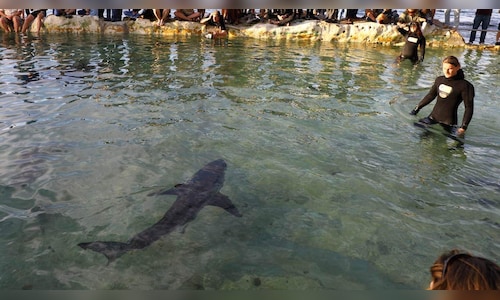
This role is crucial for a sophisticated protection network that allows swimmers, surfers, and fishers to monitor the presence of these aquatic hunters in real time as they enter the water.
Each day, workers position 305 satellite-connected buoys in popular locations where the water reaches depths of up to 15 meters (50 feet) along the New South Wales coastline as part of a state-run initiative.
Also read | US embassy in India alerts visa applicants that they may be denied entry to the consulate if…
The so-called smart drumlines utilize baited hooks, and when a shark bites, it gets caught, sending a signal to the tagging team.
Then comes the challenging part.
However, it’s not the wild “rodeo” experience one might envision, according to Paul Butcher, the principal research scientist in the state government’s shark tagging and tracking program for the last decade.
“The sharks are quite benign. The process has minimal impact on those sharks,” he mentioned to AFP.
A boat must reach the buoy within 16 minutes of the alert.
If the shark belongs to one of three potentially dangerous species—a great white, bull shark, or tiger shark—team members spring into action.
They secure two ropes around the animal: one positioned near its tail and the other in front of the pectoral fin to support its body.
Also read | Pilibhit Tiger Reserve tourist safari vehicles breach regulations by blocking tiger movement
Once the predator is brought close to the boat, it is gently rolled onto one side while ensuring seawater flows over its gills. This position induces a trance-like state in the shark, reducing the risk of harm to both the team and the animal.
Team members measure the shark’s length, gather tissue samples, and affix an acoustic tag to its dorsal fin.
Finally, the shark is released at least one kilometer (half a mile) offshore, disappearing into the deep blue with a flick of its tail.
The entire procedure takes around 15 minutes. “Some animals have distinct personalities,” Butcher noted.
“Great whites are relatively easy to handle next to the boat, whereas tiger sharks are less so. Bull sharks also tend to be quite harmless.”
In the last decade, the state’s program—managed by the Department of Primary Industries—has tagged 1,547 white sharks, 756 tiger sharks, and 240 bull sharks.
Tagged sharks can be detected as they swim past one of 37 listening stations scattered along the coastline. This triggers an alarm on the SharkSmart app, providing beachgoers with instant notifications on their mobile devices and smartwatches.
This technology is part of a comprehensive approach adopted by authorities, which also includes spotter drones and traditional nets.
Nevertheless, over 1,280 shark incidents have been reported around Australia since 1791—around 260 of which were fatal—according to a national database.
Although still relatively uncommon, fatal attacks are increasing, with 57 reported deaths in the 25 years leading up to 2025, compared to 27 in the previous quarter-century.
In November, a three-meter (10-foot) bull shark fatally bit a woman and injured her boyfriend off a secluded beach north of Sydney.
The Swiss tourists were reportedly capturing footage of a pod of dolphins.
Despite overfishing negatively impacting some shark species, experts suggest that the rise in fatalities may correlate with the increasing number of individuals entering the water. Rising ocean temperatures also seem to be influencing sharks’ migratory patterns. Researchers emphasize the need to protect shark populations as well.
Globally, approximately 37 percent of oceanic shark and ray species are now categorized as either endangered or critically endangered by the International Union for Conservation of Nature, a database for endangered species.