
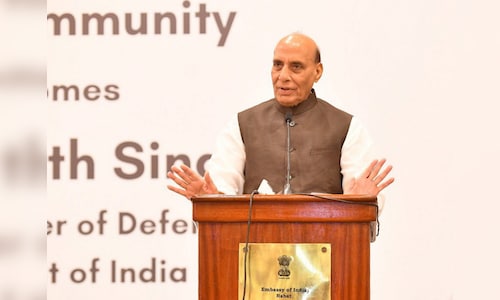
Singh referred to the car bomb explosion on November 10 near the Red Fort in Delhi, where the attackers were identified as doctors.
“Currently, we are witnessing a troubling trend of white-collar terrorism in our nation. Educated individuals are acting against the interests of society and the country,” Singh remarked during the 104th foundation day event of Bhupal Nobles’ University.
“The individuals responsible for the (Delhi) bomb explosion were doctors – those who write ‘Rx’ on prescriptions, yet have RDX in their possession. This underscores the importance of aligning knowledge with values and character,” the defence minister emphasized.
“The aim of education is not merely to achieve professional success, but also to foster morality, ethics, and human character,” he asserted.
The explosives-laden i20 vehicle that exploded outside the Red Fort on November 10, claiming 15 lives, was operated by Dr. Umar-un-Nabi.
The investigation uncovered a ‘white-collar’ terror group, resulting in the apprehension of three doctors: Muzammil Ganai, Adeel Rather, and Shaheena Saeed, among others.
Singh further noted that knowledge leads to competence, which then leads to prosperity, and from prosperity arises righteousness; ultimately, true happiness stems from righteousness.
“Any educational system that fails to achieve this goal—one that does not instill humility, a sense of character, and ‘dharma’ (righteousness) alongside knowledge—is inadequate,” Singh remarked.
“When I speak of religion, it should not be limited to visiting temples, mosques, or churches for prayer. Religion embodies a sense of duty. Education without a foundation in religion and morality may serve society poorly, and can sometimes even be detrimental. This explains why some educated individuals become involved in criminal activities,” Singh pointed out.
Terrorists are not necessarily uneducated; they may possess university or college degrees, yet they resort to terrorism due to a lack of wisdom, the defence minister stated.
“Thus, wisdom is crucial,” he insisted.
Singh also highlighted that numerous defence startups are achieving remarkable advancements in the country.
“I am optimistic that in the next 15-20 years, India will achieve complete self-reliance in weaponry,” the defence minister asserted.
He added that technologies like artificial intelligence and machine learning are revolutionizing lives and work, and they must be harnessed positively to propel India’s development.
India ranks as the world’s fourth-largest economy, aiming to become the third-largest by 2030, Singh remarked, noting that universities have a significant role in this trajectory.
He also stressed the necessity of recognizing the delicate balance between self-respect and ego, advising individuals not to blur the line between the two.
“While self-respect is essential, it should never evolve into arrogance,” Singh stated.
Encouraging students to embrace generosity, Singh said, “Avoid operating with a narrow mindset. The larger your heart, the greater your happiness.” Acknowledging teachers as the fundamental pillars of education, he noted, “In India, teachers are revered. They have initiated some of the most significant social transformations in the country.” He emphasized that values play a crucial role in life, and students should not cultivate a sense of ego.
Singh remarked that contemporary global challenges such as environmental issues, health crises, and digital ethics cannot be addressed using a single discipline.
“Solutions can only be achieved through a multidisciplinary approach. Universities should teach students not just what to think, but how to think. They must foster an environment where holistic thinking can flourish,” he stated.
“The goal of research should not simply be publication in journals; it must aim to effect change on the ground—whether in policymaking or addressing other societal issues. Universities should promote research that is focused on solutions,” he added.
Chittorgarh MP C P Joshi, Nathdwara MLA Vishvaraj Singh, and other political leaders were in attendance during the event.


