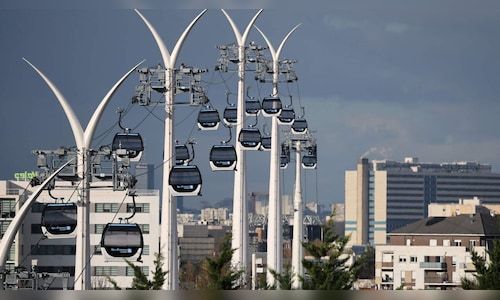
The 4.5-kilometre line links Creteil to Villeneuve-Saint-Georges, passing through Limeil-Brevannes and Valenton.
Traditionally designed for mountainous areas, these systems are now increasingly connecting isolated neighborhoods. “It’s like skiing!” quipped Ibrahim Bamba, a 20-year-old student residing in Limeil-Brevannes, which lacks metro or rail services.
“It’s the Alps on the Marne!” exclaimed Pecresse, referencing Val-de-Marne in the Grand Paris metropolis. The cable car is expected to transport about 11,000 passengers daily in its 105 gondolas, each designed to hold ten passengers.
Also read | Top 10 most peaceful countries to visit around the world
The complete journey will take 18 minutes, including stops, in contrast to approximately 40 minutes by bus or car, linking isolated neighborhoods to Paris metro’s line 8. A ride demands either a bus ticket or a travel pass valid for the Paris metro.
“This marks a significant advancement in transportation. The roads frequently experience heavy congestion in the mornings,” stated Salimatou Bah, 52, a resident of Limeil-Brevannes for thirteen years.
“We were concerned about potential hesitance, but I believe it just requires some time to adjust.”
Pecresse noted that the project represented “a 10-year obstacle course.”
Also read | Top 10 most peaceful countries to visit around the world
“We had to secure funding and reassure local residents. For Val-de-Marne inhabitants, it’s a sign of consideration,” she remarked.
The 138-million-euro initiative was deemed more cost-effective than a subway system, officials indicated.
“A subway would never have materialized due to the budget, which exceeds a billion euros and could never have been financed,” said Gregoire de Lasteyrie, vice-president of the Ile-de-France regional council overseeing transport.
Each gondola can hold ten seated passengers alongside wheelchairs, bicycles, and strollers. The interiors are equipped with video surveillance and emergency call buttons for passenger safety, in addition to station staff present.
The cable car addresses “urban divides” in neighborhoods that previously faced challenges in public transport access, according to Metin Yavuz, mayor of Valenton, a town with 16,000 residents.
This marks France’s seventh urban cable car, with aerial tramways already in operation in cities like Brest, Saint-Denis de La Reunion, and Toulouse.
France’s inaugural urban cable car was constructed in Grenoble, at the foothills of the Alps, in 1934. The iconic “bubbles” have become a symbol of the southeastern city.
Cable cars are regarded as one of the safest transportation modes globally.
In France, the last fatal incident occurred in 1999 in the Hautes-Alpes, resulting in 20 casualties.