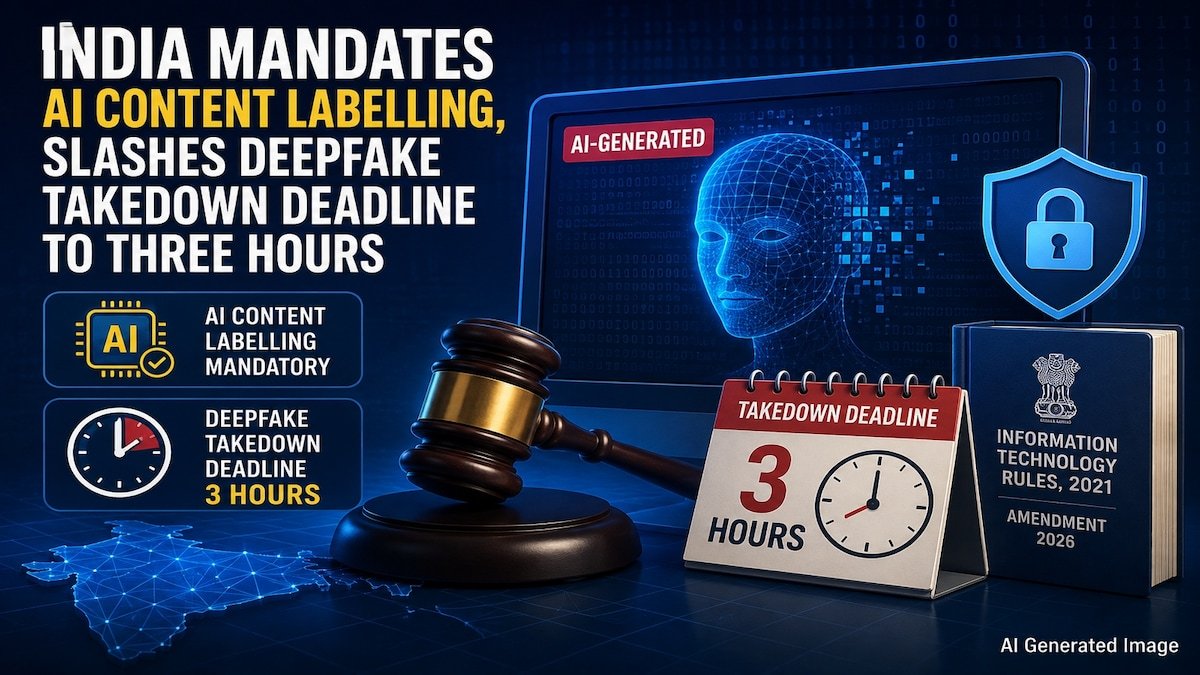
The Ministry of Electronics and Information Technology (MeitY) announced amendments to the Information Technology (Intermediary Guidelines and Digital Media Ethics Code) Rules, 2021, which were notified on February 10, 2026. These amendments require intermediaries to eliminate unlawful content within three hours of receiving a valid directive from either the government or a court. Furthermore, the revised rules expedite grievance redressal timelines, specifically for sensitive situations involving nudity and impersonation.
The amended regulations obligate intermediaries to provide clear labeling and traceable metadata for acceptable AI-generated material, helping users to recognize synthetic content and minimizing the potential for deception.
The updated framework also mandates intermediaries to apply reasonable technical measures, including automated tools where suitable, to prevent the generation or spread of AI-generated content that contravenes Indian law. Major social media intermediaries are expected to enhance proactive detection systems for content related to rape, child sexual abuse, and previously removed unlawful items.
According to the ministry, the revised rules broaden the responsibilities of platforms by explicitly addressing harmful AI-generated content, including child sexual exploitation material, non-consensual intimate visuals, and impersonation. Platforms must also raise user awareness regarding the legal repercussions of producing or sharing illegal AI-generated content and fortify their compliance mechanisms.
The government clarified that this framework is supported by existing provisions under the Information Technology Act, 2000, and the Bharatiya Nyaya Sanhita, 2023, which impose penalties for offenses such as identity theft, impersonation, forgery, misinformation, and cybercrime.
The ministry further stated that intermediaries failing to adhere to their responsibilities under the IT Rules may lose the safe harbor protections provided under Section 79 of the Information Technology Act, potentially exposing them to legal actions under applicable laws. Additionally, the government is promoting AI governance and deepfake detection through the IndiaAI Mission, showcasing projects like Saakshya, developed by IIT Jodhpur and IIT Madras, AI Vishleshak for audio-visual forgery detection, and IIT Kharagpur’s real-time voice deepfake detection system.
The Centre also emphasized enforcement mechanisms like the Grievance Appellate Committees, the Indian Cyber Crime Coordination Centre (I4C), the SAHYOG portal, and the National Cyber Crime Reporting Portal, which enable users and authorities to report illegal online content, including deepfakes, and request its removal.