
While the company has kept its earnings before interest, taxes, depreciation, and amortisation (EBITDA) margin guidance at 27% to 28% for the time being, Banerjee noted that the performance in the first half will influence any potential upward revision.
Banerjee stated that Dr. Lal PathLabs will keep prioritizing investments even if profitability sees further improvements, emphasizing that enhanced margins might spur quicker investments aimed at future expansion instead of merely boosting profitability.
He also highlighted that Dr. Lal PathLabs is exploring inorganic opportunities in regions where its presence is relatively limited, specifically targeting South India and Gujarat for possible acquisitions, evaluating prospects on a case-by-case basis based on valuations and strategic alignment.
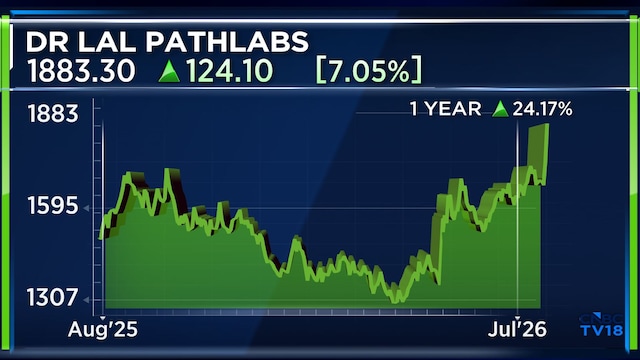
Currently, Dr. Lal PathLabs boasts a market capitalisation of ₹31,552.78 crore and has seen its stock rise over 24% in the last year.
This is an edited transcript of the interview.Q: Revenue increased by 19% year-on-year in the quarter. I want to begin by asking—this is something we’ve revisited consistently. Sample volumes increased about 11%, while patient volumes rose around 8%. Is it primarily a case of more tests per patient? This seems to be the driving factor. Perhaps a mix of specific specialized tests, SwasthFit? What’s behind this divergence, and can we expect it to continue?A: The positive trend in double-digit sample volume growth, along with the mix of tests and geography, is contributing to the realization discrepancies we’re observing. In this quarter, we’re also experiencing a slight boost as the CGHS and ECHS price hikes are beginning to take effect; we anticipate this to continue over the next few quarters. Nonetheless, the core contributors remain sample volumes, patient volumes, and an improved geography and test mix.
Q: So, the price hikes for CGHS and ECHS have primarily driven the realization gains this quarter.A:
Not solely the majority. Among the total realization improvement, which falls between 8% and 10%, about 2% to 3% is due to the CGHS and ECHS price alterations. We’ve consistently achieved a realization improvement of around 6% to 7% through our test and geography mix in recent quarters, which is part of our core organic business strategy. This continues, but this quarter, the CGHS and ECHS boost is also in play.
Q: EBITDA margins were at 31% in the first quarter. Yet, you’ve stuck with your margin guidance of 27% to 28%. Do you foresee a potential decline in margins? What investments is the company planning that justify not updating the margin guidance?A: Firstly, this reflects just one quarter. We want to monitor our performance through the first half to provide more accurate and confident margin guidance.
Having said that, we have always prioritized investing for future growth. If the margin profile appears better than anticipated, we might slightly elevate our investments to ensure sustained growth moving forward.
This approach has been consistent for nearly 24 months now, and we are starting to see some of the results materializing. We will maintain this strategy and will supply a more confident margin forecast after the first half concludes.
However, given the recent improvements in revenue and margin structures during the first quarter, there might be an upside potential within this financial year.
Q: So, there’s a chance of raising the margin guidance based on the second quarter numbers, correct?A: It’s a possibility, but as mentioned, our strategy predominantly revolves around investing for growth. Should the margin profile appear more favorable, the pace of our investments may increase.
Q: You’ve also referenced inorganic opportunities. You have the cash; are valuations in the diagnostic sector becoming more appealing?A: We are considering specific opportunities. Certain regions, particularly in the South, where we are comparatively weaker in terms of brand strength, and in Gujarat, are under our radar for inorganic ventures.
These are areas where we’ve been actively seeking acquisitions, and we will continue to pursue them. As for valuations, they will need to be discussed and assessed on a case-by-case basis according to the nature and structure of each opportunity we ultimately select.
For the complete interview, watch the accompanying video

Catch all the latest updates from the stock market here