IMAX screens had a significant impact on these numbers. IMAX Corporation reported to CNBC-TV18 that the film garnered $52 million in global IMAX box office revenue over the weekend, achieving its best opening ever in similar markets excluding China, Japan, and South Korea, reflecting a 16% increase over the previous record, and accounting for 20% of the film’s total global debut.
In India, IMAX noted that the film contributed ₹14.6 crore to the weekend box office, indicating that about a quarter of the opening weekend earnings came from a format that is still emerging in the country.
The advance booking trends highlighted the film’s draw. Ashish Saksena, COO – Cinemas at BookMyShow, told CNBC-TV18 that 1.5 million tickets had already been sold on the platform, emphasizing “the deep engagement Indian audiences have with global cinema and the country’s increasing significance in the global theatrical landscape.”
However, the more compelling narrative lies not in the figures, but in how Nolan achieved this success.
Also read: Marvel unveils ‘Ghost Rider,’ ‘Black Panther 3’ at Comic-Con
A premiere, a press conference, a podcast
Two weeks ago, Mumbai experienced an unusual Hollywood moment. Christopher Nolan, who typically avoids extensive global promotional tours, made an exceptional visit alongside stars Tom Holland and Matt Damon ahead of The Odyssey’s release.
Nolan arrived in Mumbai with lead actors Matt Damon and Tom Holland for a two-day promotional event on July 10–11, 2026, featuring a red-carpet premiere—his first-ever film premiere in India.
“I’ve never been anywhere in the world where there’s such an appreciation for what movies can be and should be for audiences, and to me, it seemed absurd that we wouldn’t bring our films here for premieres,” the Oscar-winning director remarked at a Mumbai press conference.
The visit included more than the typical promotional activities: Damon and Holland engaged in an extended discussion with Indian content creator Prakhar Gupta during their time in the city.
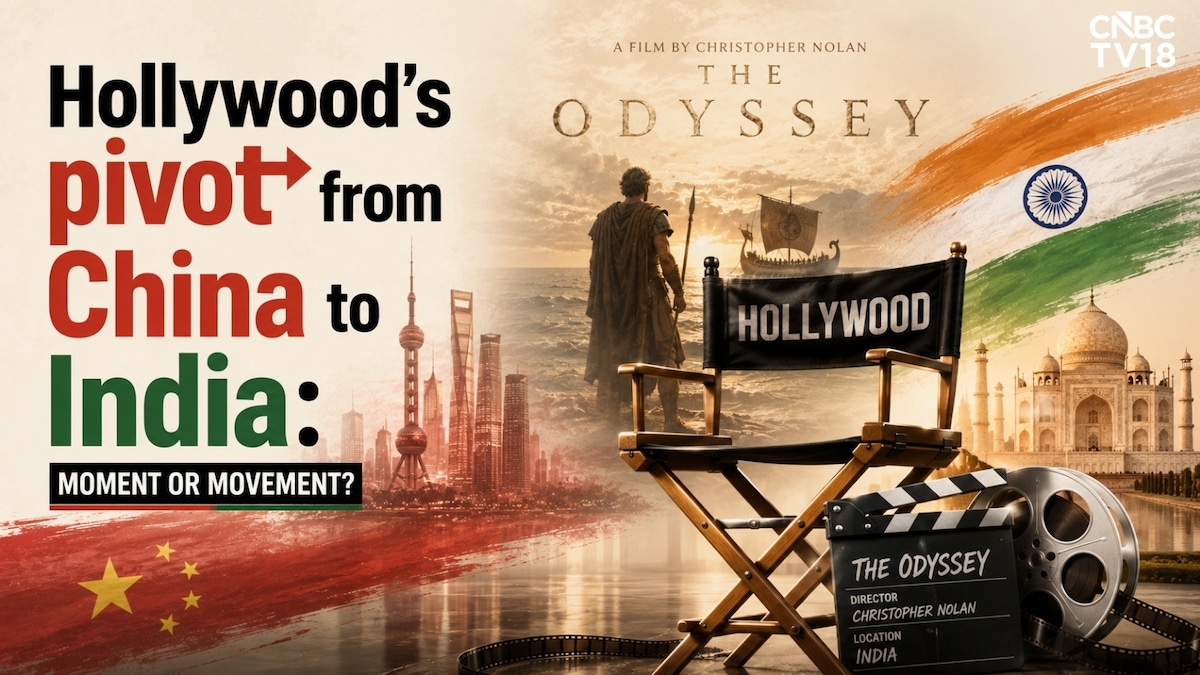
While the stars have departed, the excitement has only amplified. With Christopher Nolan’s The Odyssey achieving blockbuster box office figures globally, the film has become more than just a cinematic release—it underscores India’s growing role in Hollywood’s global marketing strategy.
This spectacle of star power makes for captivating viewing. The more pertinent question is: why now?
The answer: a shrinking China market
The emphasis on India becomes clearer against the backdrop of Hollywood’s diminishing foothold in China, previously its most crucial growth market outside North America.
Hollywood studios once commanded 35%-40% of China’s box office, according to an Omdia/Informa analysis. By 2024, this share had fallen to 21%; by the first half of 2025, it plummeted to only 5.5%.
This decline has been ongoing since Beijing imposed quotas on Hollywood imports in 2012 and tightened censorship beginning in 2018, which escalated sharply this year. Following the Trump administration’s tariff increase on Chinese imports in 2025, Beijing retaliated by further restricting Hollywood film imports, leading studios to anticipate negligible revenue from China for major releases.
A separate 2026 trade analysis indicated that by March 2026, the tariff environment had made Hollywood’s access to the Chinese market “nearly impossible.”
Notably, The Odyssey will not debut on Chinese IMAX screens until August 14, more than a month after its global launch and after South Korea (August 5), as per IMAX’s release schedule.
India’s infrastructure is catching up
The shift toward India isn’t occurring in isolation; the exhibition infrastructure is gradually scaling up in response, albeit slowly.
This year, India’s box office hit a record of ₹13,400 crore, according to PVR INOX’s Q3 FY26 earnings disclosures. As of February 2025, IMAX operated 31 screens in India, with plans for 14 more and a target of 150 by 2029—modest relative to China’s nearly 800 IMAX screens, but a clear indication of intent.
Indian multiplex chains are also quickly transitioning to premium formats. PVR INOX executives noted in January 2026 that premium and recliner-format screens achieved 35-40% occupancy rates, compared to 28-30% for standard screens, prompting increased investment in large-format expansions.
Meanwhile, audiences are demonstrating minimal price resistance. Premium IMAX tickets for The Odyssey reached ₹3,300 in Mumbai and Pune, among the highest movie ticket prices recorded in India, and showings are consistently sold out.
Saksena interprets this as a conscious choice, not merely a response to demand. “The exceptional interest in IMAX screenings is particularly significant,” he stated. “It shows that audiences are deliberately choosing to experience The Odyssey in the format Christopher Nolan envisioned, reinforcing the lasting appeal of premium, large-format cinema.” He described it not just as a release, but “a cultural event, exemplifying the unique power of the theatrical experience.”
What analysts make of it
Not all analysts see these figures as a structural turning point. Karan Taurani, EVP for Media, Retail, Consumer Discretionary and Internet at Elara Capital, noted that while the box office surge is real, its impact may be limited.
The media analyst predicted The Odyssey could earn “between ₹160 to ₹180 crores net box office in India,” which he considers significant given that “earlier films by Christopher Nolan have typically reported lower box office figures, including Oppenheimer.”
He attributed the increase to rising ticket prices and the greater penetration of IMAX over the last five years, combined with a straightforward supply shortage: “India has only about 35 to 40 IMAX films, which is less than 1% of penetration… this opening weekend was genuinely strong due to the demand-supply mismatch in the scarcity of IMAX films in India,” a perspective that aligns with IMAX’s cited ₹14.6 crore from a small portion of the nation’s screens.
Looking forward, Taurani expressed more caution than the box office figures might suggest. “Structurally, the challenges remain,” he said. “One being consistency in content and the other being the sustainability of such content on a regular basis, which can support average ticket prices (ATP).”
He pointed out that Hindi cinema, which constitutes 50-55% of the multiplex box office, “has not maintained these high ticket prices consistently,” as tentpole events like this are exceptional: “You see titles like Durandar once a year or every six months. However, apart from that, other films don’t possess the ability to command similar ticket prices.”
“The net overall effect for multiplexes is undeniably substantial in the grander scheme of things: regarding food, ticket prices, metrics,” the media analyst noted, adding, “But it cannot be the only game-changing element we encounter.”
So, is this a moment or a movement?
That’s the query the industry is currently grappling with. And the answer, based on the present circumstances, is: it hinges on what follows.
IMAX, for its part, is banking on more than just one big weekend. CEO Rich Gelfond described The Odyssey as part of “a rarified group of instant classic blockbusters in IMAX history that fully leverage our platform,” adding, “As optimistic as we are about its success, our experience indicates that even we are uncertain of how this movie will enhance our brand and business.”
When asked whether India can look forward to a steady stream of IMAX-format Hollywood films rather than just a one-off, the company referenced its lineup for 2026-27, which includes Dune: Part Three, Tom Cruise’s Digger, The End of Oak Street, The Dog Stars, and two India-oriented projects, Ramayana – Part 1 and Varanasi.
Denzil Dias, VP & MD, India Theatrical at Warner Bros. Discovery, argues that this isn’t solely a story defined by one genre revolving around a central tentpole. He points to Obsession, a moderately budgeted horror film without a star-studded cast, which he claims is nearing ₹100 crore in India and has become the second-highest-grossing Hollywood horror release in the country’s history; Lee Cronin’s The Mummy, which grossed ₹36 crore; and the music biopic Michael, which earned ₹81 crore and became India’s top-grossing music biopic.
“What ties them together is neither genre nor budget,” Dias stated. “It is the quality of their craft and the dedication to providing Indian audiences something worth leaving home to see.”
According to Dias, Warner Bros. and Universal Pictures India collectively captured nearly 50% of Hollywood’s India box office in 2025, and the two studios accounted for 60% of Hollywood’s India business in the first half of 2026, by his calculation. “We are not in the India market merely to participate,” he asserted. “We aim to lead it.”
Taurani’s skepticism provides a necessary counterbalance: a genre that has never exceeded 10% of box office, ticket prices that soar for marquee weekends and then revert, and an Indian film industry that undoubtedly dictates when multiplexes generally see high attendance.
When aligning the two perspectives, a clear picture forms: Hollywood isn’t entering India by chance; it’s pursuing the only large, still-open avenue remaining as China continues to tighten its grip quarter by quarter.
PVR INOX’s Gautam Dutta, CEO – Revenue and Operations, observes a similar trend from the exhibition perspective. He suggests Hollywood no longer merely attracts Indian audiences on spectacle alone; it’s nurturing a more consistent, content-agnostic demand that extends well beyond major tentpole releases.
Is Hollywood’s success in India limited to big-budget blockbusters?
Over the years, viewers have embraced a more diverse array of Hollywood releases, with compelling storytelling, positive word-of-mouth, and active social media discussions increasingly driving theatrical attendance. Recommendations, early audience feedback, and online buzz now play roles as critical as franchise appeal.
“While blockbuster franchises continue to capture attention, Indian audiences are no longer selecting Hollywood films based solely on scale,” Gautam Dutta remarked.
“The inquiry is no longer whether a film belongs to a major franchise, but whether it promises a memorable theatrical experience.” When a film fulfills that expectation, Indian audiences have consistently demonstrated their willingness to attend, regardless of its affiliation with an established cinematic universe.
This trend, Dutta believes, indicates a maturing theatrical market; one where Hollywood’s influence in India stretches well beyond spectacle to include quality storytelling across a variety of genres.