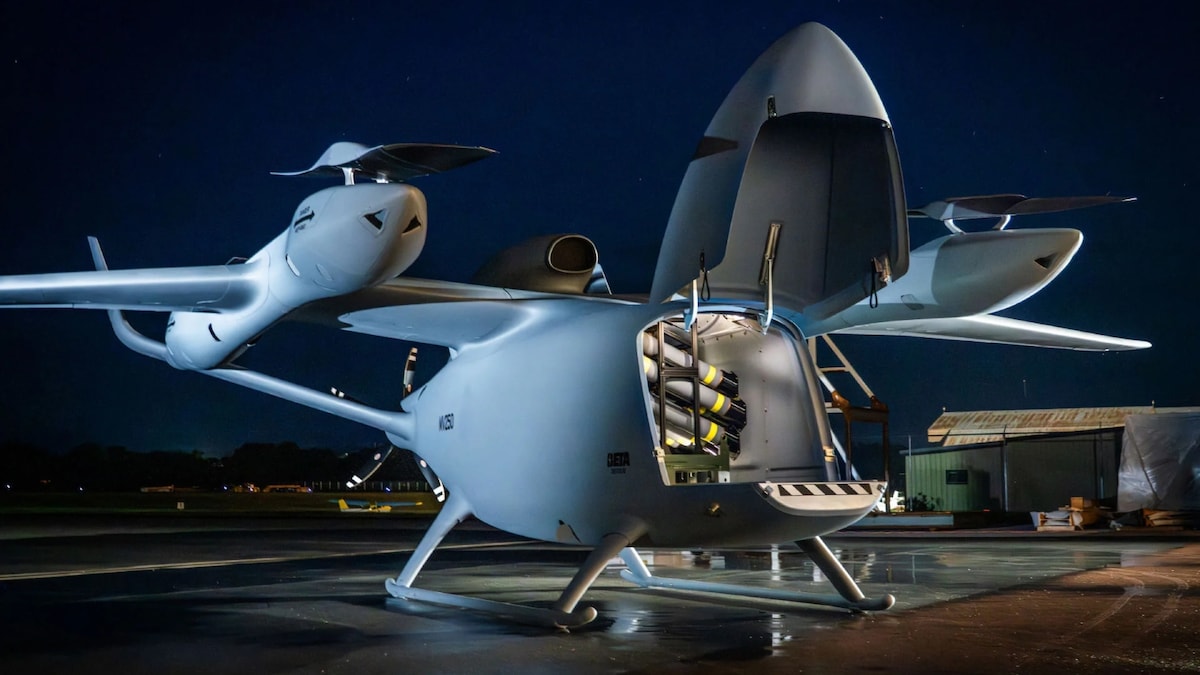
According to the US-based aerospace company, the MV250 serves as a defense variant of Beta’s fully electric A250, which is a crewed vertical takeoff and landing aircraft.
It retains the A250’s configuration but eliminates cockpit seats and the passenger cabin. The development was a collaboration with GE Aerospace and Sikorsky, part of Lockheed Martin.
Range And Load
The MV250 is capable of repositioning over 1,300 nautical miles (2,400km), operating within a tactical range of 250nm, and carrying a payload of up to 907kg (2,000lb).
Founder and CEO Kyle Clark stated that its design offers enhanced range, increased speed, and reduced operational costs compared to tiltrotor and older military aircraft, integrating Beta’s technology with systems from GE Aerospace and Sikorsky at a lower acquisition cost and lighter logistics burden.
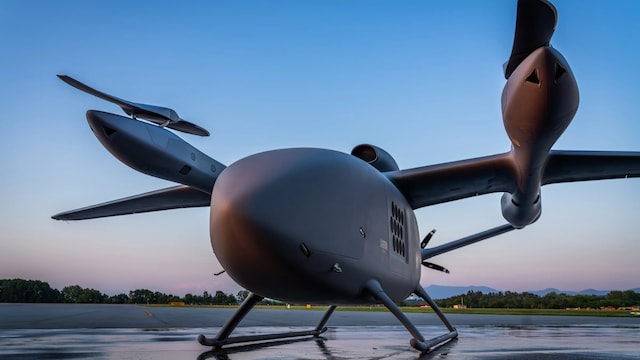
Beta MV250 autonomous hybrid-electric VTOL.
While Beta’s commercial aircraft operate on batteries alone, a hybrid-electric system was chosen for the MV250 to accommodate military requirements, offering reliable electric engine performance and low maintenance, along with extended range and ground power generation.
The turbogenerator was co-developed by GE Aerospace and Beta under a technology-sharing agreement, based on GE’s T700/CT7 engine, also used in the Sikorsky UH-60 Black Hawk and Boeing AH-64 Apache.
This design closely integrates electromagnetics and power electronics with the turbine, enhancing efficiency and durability while reducing weight and costs.
GE Aerospace defense chief Amy Gowder, who also serves on Beta’s board, indicated that the turbogenerator utilizes GE’s propulsion expertise to extend range and mission versatility.
Flying Without Pilots
Sikorsky’s Matrix system will facilitate uncrewed flight, having previously flown the Black Hawk and Sikorsky’s developing Noman uncrewed aircraft. Beta also operates its own autonomy system.
The MV250’s open, modular flight controls comply with US military standards and can integrate various autonomy and mission systems. Sikorsky’s Rich Benton mentioned that the aircraft expands uncrewed options for commanders in contested environments.
Beta envisions the MV250 carrying equipment, munitions, medical supplies, and cargo. Built on existing production lines, it aims to reduce development and testing expenses, with expectations of participating in further military exercises.
Testing Track Record
Two other Beta aircraft are currently in testing: the crewed A250 and the conventionally landing CX300, which has recently commenced limited commercial flights as part of a new FAA pilot program.
The two aircraft share 80% of their components, including cockpits and controls, and are produced at Beta’s Burlington, Vermont facility. The CX300 is scheduled to fly at Farnborough this year after its debut in Paris last year.
Just before the airshow, a Beta conventional takeoff aircraft conducted 30 logistics sorties during NATO’s Aurora 26 exercise in Sweden, at the invitation of the US Army. Beta’s ALIA aircraft family has accumulated over 160,000 nautical miles, and the company operates more than 100 charging stations globally.
Rivals Circle
Competitors are also making moves. Joby Aviation’s S4-T is a hybrid-electric, autonomous logistics variant of its S4 passenger aircraft. Meanwhile, Archer Aviation is collaborating with Anduril Industries on the Thunder, a large uncrewed tiltrotor aircraft intended for strike missions.