Renewed hostilities in West Asia have once again unsettled the markets. The most recent series of tensions arose after Iran announced it had attacked a vessel navigating an unauthorized route, subsequently declaring the closure of the Strait of Hormuz.
The US Central Command later reported conducting strikes on Tehran, to which Iran responded by targeting American-linked facilities in the United Arab Emirates, Kuwait, and Bahrain.
Analysts indicated that any further intensification of the conflict could push crude oil prices higher, reignite inflation concerns, and bolster safe-haven assets like the US dollar and Treasury yields, which could limit gains for precious metals.
”For gold and silver, the momentum remains downward and corrective. Attention will shift back to the US-Iran conflict. Any major escalation would again elevate oil prices and strengthen safe-haven assets such as the US dollar and Treasury bond yields,” stated Pranav Mer, Senior Vice President, EBG – Commodity & Currency Research, JM Financial Services Ltd.
In addition to geopolitical factors, markets will keep a close eye on inflation data from India, the EU, and the United States for new insights into the monetary policy direction of major global central banks, he added.
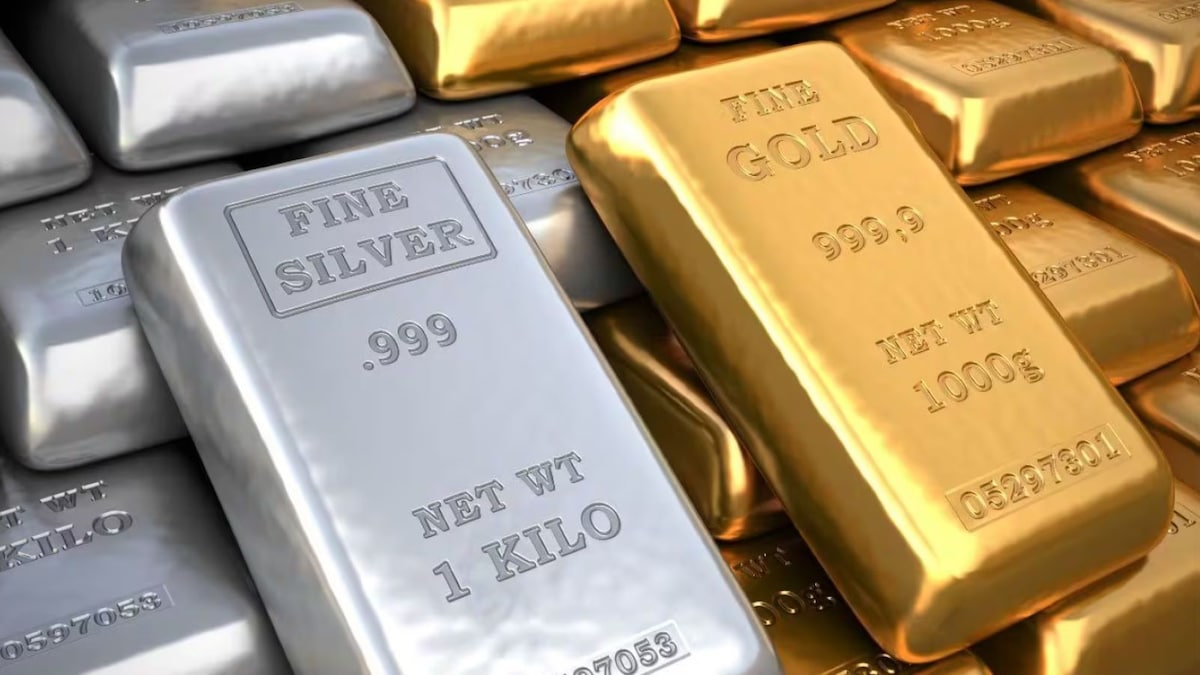
Domestically, MCX gold futures for August delivery decreased by ₹3,900, or 2.65%, during the week, closing at ₹1.43 lakh per 10 grams.
Silver for the September contract also dropped ₹14,746, or 6.2%, to ₹2.22 lakh per kilogram.
”Gold experienced another quiet week, declining over 2%, as a combination of a stronger US dollar, stable crude oil prices, and expectations of rising interest rates continued to impact investor sentiment,” remarked Jateen Trivedi, VP Research Analyst, Commodity and Currency, LKP Securities.
Despite occasional recovery attempts, bullion struggled to maintain gains, with each rally drawing fresh profit-taking, he noted.
”The Indian rupee also saw a slight correction, which provided limited support to MCX gold. However, the effects of currency depreciation were largely countered by bearish global sentiment, leading gold to persist in its corrective phase,” Trivedi added.
In international markets, Comex gold futures declined by $12, or 0.3%, to close at $4,113.7 per ounce in New York, while silver decreased by $1.5, settling at $60.16 per ounce.
Analysts mentioned that market participants will closely observe a series of significant US economic indicators, including retail sales, housing data, and weekly jobless claims, for further insights into the Federal Reserve’s policy direction.
Chinese economic indicators like GDP growth, industrial production, fixed asset investment, bank lending, and trade statistics will also be significant, as they could influence the outlook for industrial metals, which have shown signs of recovery in the recent sessions, noted Pranav Mer.
According to Trivedi, the persistent inability of bullion prices to retain gains illustrates a cautious market where investors prefer to use rallies for profit-taking rather than initiating new bullish positions.
”Unless there’s a notable shift in geopolitical events or macroeconomic indicators, sentiment remains cautious until stronger fundamental triggers emerge,” he concluded.
Also Read: India, Canada conclude third round of talks on proposed trade pact