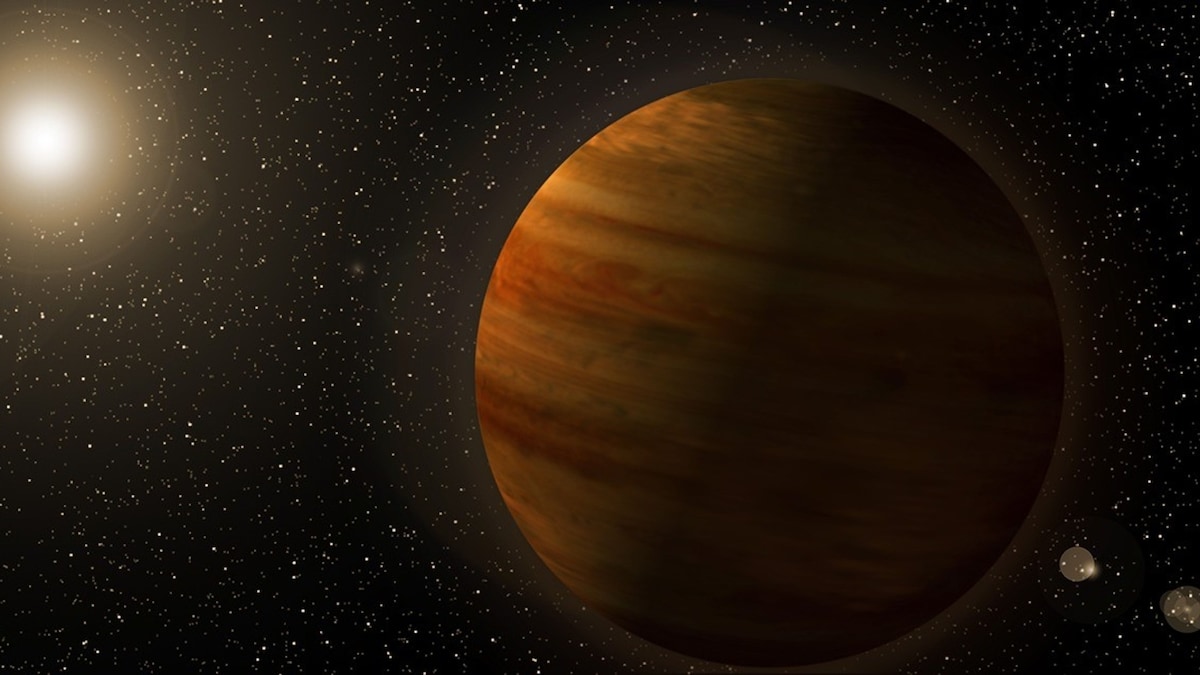
In contrast to the typically close-in transiting planets identified by TESS, the newly found planet is a super-Jupiter, orbiting far from its host star every 180 days, as reported by a team from Queen’s University Belfast.
This planet, named Gaia23bra b, possesses a mass approximately 1.6 times that of Jupiter. Such large planets are often termed super-Jupiters. Additionally, it qualifies as an exoplanet, which refers to any planet located outside of our solar system.
Diana Dragomir, a professor at the University of New Mexico in Albuquerque and co-author of the study, remarked that the capabilities for discovering this type of planet were not anticipated when TESS was launched.
She noted, “With a mass of 1.6 times that of Jupiter and a similar orbital distance, finding such a planet using TESS’s primary detection method would be extremely improbable. This discovery suggests that there may be other microlensing planets concealed within TESS’s data that we hadn’t previously considered.”
Initially, astronomers detected signs of Gaia23bra b in 2023 using the European Space Agency’s now-retired Gaia space telescope. Gaia’s alert system flagged a star that suddenly became brighter, an occurrence that can happen when a foreground star passes in front of a more distant star, magnifying its light through gravitational microlensing.
Subsequent analysis of archived TESS data revealed that the spacecraft had also captured this event.
Published on July 1 in The Astrophysical Journal Letters, the team’s findings indicated that Gaia23bra b orbits an orange dwarf star with about 80% the mass of the Sun. The planet is situated nearly 40,000 light-years away from Earth, well beyond TESS’s typical search range of around 150 light-years.