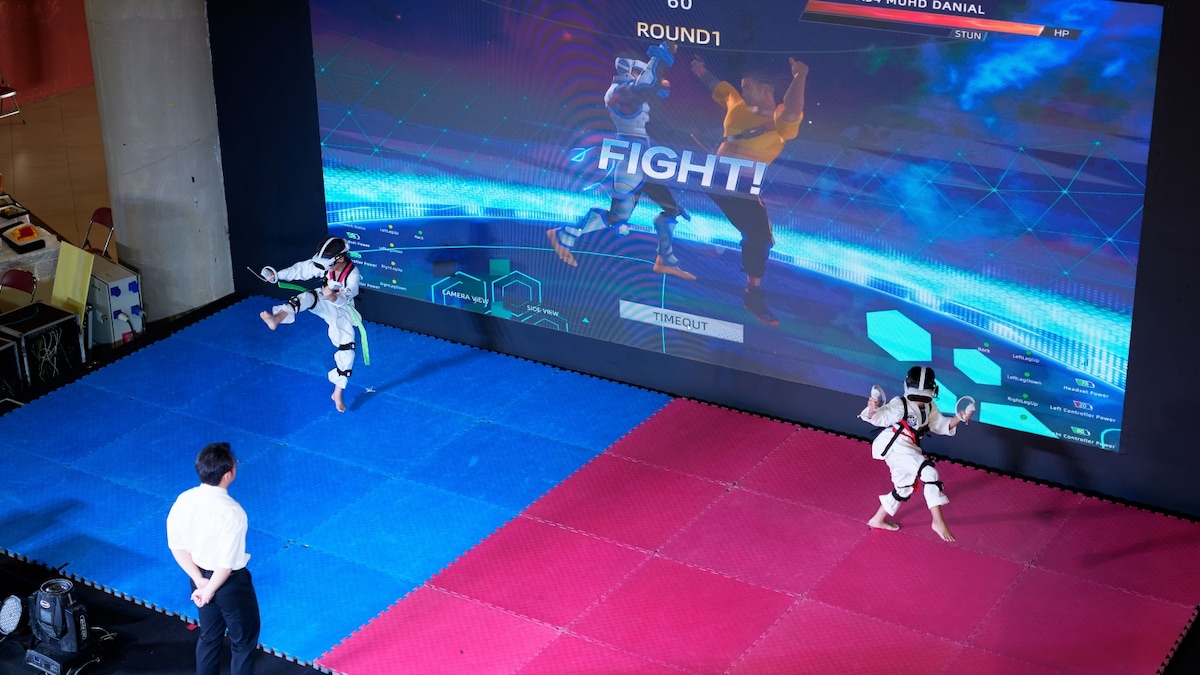
“I was just kicking into the air,” the 21-year-old recalled. Despite being a national taekwondo champion, she faced challenges in the virtual arena, lacking knowledge on strategies, skills, or how the technology functioned.
Two years later, she achieved a gold medal at a recent virtual taekwondo event in Malaysia and became part of an expanding community engaged in this gamified combat sport across Southeast Asia.
What was once an unfamiliar and experimental format, virtual taekwondo is now becoming a well-defined competitive discipline. Co-developed by World Taekwondo and the Singapore-based Refract Technologies, it merges virtual reality technology with conventional taekwondo techniques to attract tech-savvy young athletes.
Competitors wear VR headsets that immerse them in a digital 3D arena, while motion-tracking sensors are strapped to their spine, thighs, and shins. They control digital avatars in noncontact virtual matches, where each swift and accurate strike reduces the opponent’s virtual health.
Unlike traditional taekwondo, which separates competitors by age, weight, and gender, virtual taekwondo allows everyone to compete in the same digital environment.
This innovative approach was highlighted at Singapore’s Olympic Esports Week in 2023 and hosted its inaugural World Championships in Singapore in 2024. The sport will debut at the Asian Games in Japan this year and aims to be featured in the 2027 Southeast Asian Games in Malaysia.
A demanding sport with minimal injury risk
During last month’s competition in Malaysia, athletes and coaches emphasized how the discipline is altering views on both martial arts and gaming.
Singapore national athlete Brian Peh, 46, who was initially uninterested in gaming, joined the 2024 championship with his son out of curiosity. Both won gold and have participated in numerous local and regional events since then.
Peh has also begun training students in virtual taekwondo at his dojang, or training hall.
“I always tell parents: your kids love games. Would you prefer them using their hands or their legs?” he stated. “Once they don the headset and start competing, their energy skyrockets. They can enjoy it for hours.”
Cambodian coach Vandy Yiv noted that increasing numbers of children and parents in his country are becoming interested due to the low risk of injury. In a local tournament earlier this year, he reported more participants in virtual taekwondo compared to traditional events.
Initially perceived as a video game, many quickly realized it is a physically demanding combat sport. “Your entire body is engaged. There is action, but no injuries,” he asserted. Vandy expressed optimism about virtual taekwondo becoming an Olympic medal event in the future.
Some athletes found their first encounters disorienting, experiencing dizziness until they acclimated to the virtual setting. However, many teen players were immediately drawn to the gamified experience, as matches involve intense, fast-paced rounds lasting just one minute each, which necessitates constant offensive pressure.
For Nguyen, achieving success required understanding that virtual taekwondo demands more than simply throwing kicks. “You have to anticipate your opponent’s moves and act first,” she explained.
Athletes must possess excellent spatial awareness
While competitions are held in an immersive environment, coaches emphasize that success relies on both physical conditioning and technical skill. Athletes still perform front kicks, turning kicks, and spinning techniques, where success is determined by the speed of execution, not just impact force.
“Our training focuses first on stamina, muscle endurance, and flexibility. Then we move on to skills and strategies,” Malaysian coach Henry Lee mentioned during a recent training session. “Strength equates to how quickly your leg can lift and strike. Speed becomes your power.”
Lee, also an elite national taekwondo athlete, seeks players with solid physiques and a keen sense of “game sense” — the ability to read movements and make quick decisions in the virtual arena.
One of his students, 12-year-old Victoria Siow, noted that the challenge is in gauging distance that she cannot physically perceive.
“You have to work on your mind — deciding when to kick and how far to move,” she explained during training. “It feels like both a game and a dream.”
For Raja Mardiah Idris, 45, training at the same club has allowed her to explore opportunities that traditional sparring could not provide. It enables older athletes and women to compete safely and fairly. Her young daughter has also taken to the sport, offering a healthy alternative to screen time.
“When you wear the VR headset, everyone is on equal footing,” remarked Raja, a member of a state royal family. “Victory comes from your technique, strategy, and fitness.”
Raja plans to transition away from full-contact kyorugi sparring to focus on virtual taekwondo. She maintains her strength through running and gym workouts, hoping to represent Malaysia in virtual taekwondo at the SEA Games next year.
Malaysia’s national virtual taekwondo coach Tony Lee noted that the sport is still developing. While costs of equipment are high and access remains limited in the region, he believes rising interest will encourage clubs to invest. Malaysia now has national programs and coaching certification courses in place.
“Virtual taekwondo is our future, as young people are drawn to gaming,” he concluded.