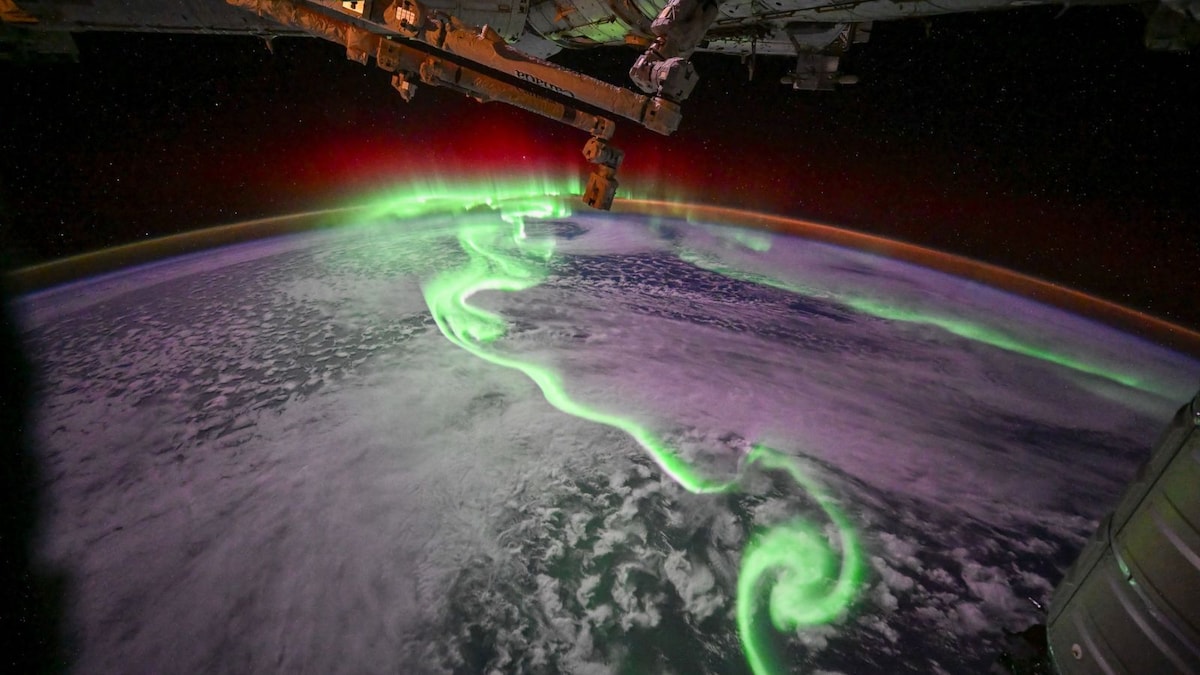
The video, captured during her epsilon mission and made public on July 2, depicts a vibrant band of green light shimmering through Earth’s atmosphere as the ISS traverses above.
‘Most breathtaking aurora’ of the mission
In a post on X (formerly Twitter), Adenot described it as the “most breathtaking aurora” she has experienced during her mission.
“Day 139, orbit 2155 – After taking some photos, I’m excited to finally share with you the timelapse of the most breathtaking aurora (to date!) from the epsilon mission!” she expressed.
She remarked on the challenge of “not succumbing to the magic of the moment” as she observed the green light dance across Earth’s atmosphere, noting that the music accompanying the video was selected to capture the emotions she felt while witnessing the scene from space.
Jour 139, orbite 2155 – Après les photos (disponibles en HD sur mon compte Flickr), je suis très heureuse de pouvoir enfin partager avec vous le timelapse de l’aurore la plus spectaculaire (jusqu’à présent !) de la mission εpsilon !
???? Difficile de ne pas céder à la magie de… pic.twitter.com/ppWi7Yc0kH
— Adenot Sophie (@Soph_astro) July 2, 2026
Why auroras illuminate
Auroras emerge when charged particles from the Sun interact with gases in Earth’s upper atmosphere, particularly near the poles. These collisions yield vibrant displays, predominantly green, but also red and purple hues. The US National Oceanic and Atmospheric Administration (NOAA) notes that heightened solar activity can enhance the brightness of auroras and extend their visibility beyond the polar regions.
Previously, NASA astronaut Jessica Meir also shared a timelapse of the Southern Aurora (Aurora Australis) filmed from a SpaceX Dragon spacecraft following a recent solar event. Collectively, these videos provide rare astronaut perspectives of Earth’s colorful polar light displays from orbit.
From their vantage point in space, astronauts experience auroras differently compared to observers on Earth. Rather than gazing upward at the lights, they see a luminous band encircling the planet, flowing through the upper atmosphere.
Sophie Adenot’s epsilon mission
Adenot arrived at the ISS on February 13 as part of NASA’s SpaceX Crew-12 mission. Her nine-month epsilon mission encompasses scientific research across biology, medicine, physics, and technology, along with Earth observation and educational outreach.
In addition to their stunning beauty, auroras serve as a visible testament to the Sun’s influence on Earth. Intense solar activity that generates these displays can also disrupt satellites, radio communications, navigation systems, and power grids, underscoring the importance of space weather monitoring in safeguarding astronauts and vital infrastructure.