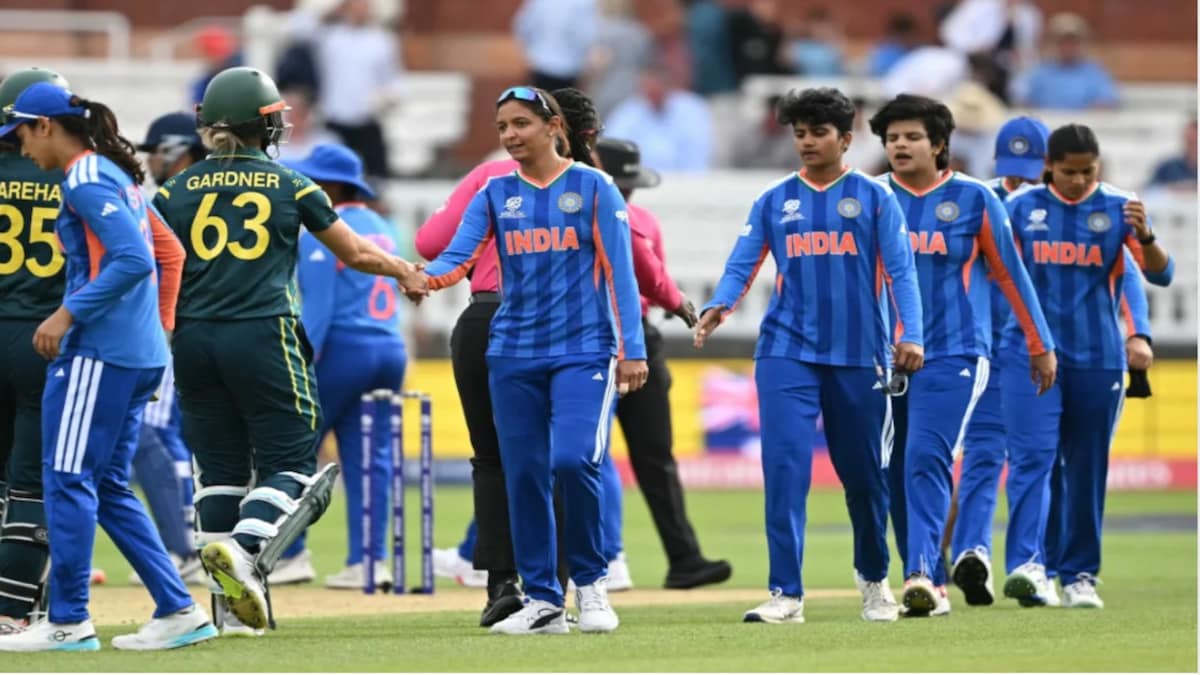
The six-wicket loss against Australia on Sunday, which dashed India’s hopes for a semi-final berth, showcased the difficulties faced by a squad that began the tournament as one of the favorites yet struggled to maintain consistency.
This defeat marked the second consecutive Women’s T20 World Cup where Harmanpreet’s leadership saw India falter before the knockout stage, prompting renewed questions about the team’s trajectory.
Both Harmanpreet and head coach Amol Muzumdar recognized the necessity for a “rethink” post-tournament, indicating that significant changes could be imminent.
Less than a year after guiding India to its first Women’s ODI World Cup title, the 37-year-old is now under pressure in the T20 arena, despite holding the title of the nation’s most successful T20I captain.
However, Muzumdar has voiced support for the veteran. “It’s up to the selectors to decide the captain. I think, yes. My short and sweet answer would be yes,” he responded when asked about Harmanpreet’s continuation as captain.
Yet, it’s difficult to overlook that under her guidance, the team has underperformed across all three facets in England.
India entered the tournament without a stable lineup, frequently altering player combinations and batting orders, often appearing reactive rather than proactive in high-pressure scenarios.
Ultimately, whether she remains captain will depend on how selectors perceive India’s recent World Cup shortcomings.
Harmanpreet’s own batting performance also warrants examination.
Since the 2024 T20 World Cup, the skipper has only surpassed the fifty-run mark four times in 24 innings, illustrating her uneven form.
Her resilient innings against Australia, played while India’s tournament dreams hung in the balance, showcased her talent and knack for performing under pressure. However, it was her sole significant contribution with the bat throughout the tournament.
In earlier matches, Harmanpreet struggled to assert herself during middle overs, failing to provide the stability or acceleration expected from the team’s most seasoned batter.
Unsettled combinations
For a squad with championship aspirations, India spent an alarming amount of time trying to pinpoint their ideal XI.
Concerns regarding the pace attack, middle-order structure, and all-round options persisted, even in the tournament’s later stages.
The team utilized various seam attacks across five group matches. Nandani Sharma and Kranti Gaud participated in three matches each, while Renuka Singh and Arundhati Reddy featured in only two games each.
Injuries to pace-bowling all-rounder Amanjot Kaur and off-spinner Shreyanka Patil further complicated their troubles.
While Muzumdar defended the bowling unit by citing inexperience, India’s challenges cannot be attributed solely to that.
Among the eight frontline bowlers in the squad, four boast over 50 T20I matches.
Ironically, one of the least seasoned among them, left-arm spinner Shree Charani, stood out as India’s leading bowler with 14 wickets in five matches at an economy rate of 5.85.
Additionally, the limited utilization of seasoned players like Renuka has raised eyebrows.
Defensive approach
India have repeatedly mentioned their intention to adopt a fearless style of play, yet their tactics often appeared overly cautious.
The middle overs remained problematic as the batting unit consistently lost momentum following the powerplay.
Yastika Bhatia and Jemimah Rodrigues, anticipated to anchor the middle order alongside Harmanpreet, faced disappointing outings.
Neither player is known for power-hitting, yet India persisted with both. While Jemimah batted at No. 3 during the England series leading up to the World Cup, Yastika was elevated to one down in the ICC event.
The tactical confusion was glaring in the crucial match against Australia.
Jemimah, struggling to find boundaries consistently, was sent in at No. 3 when a more aggressive bat was needed.
The middle order’s inability to accelerate invariably placed excessive pressure on Richa Ghosh and Deepti Sharma, who had to accomplish too much in too little time throughout the tournament.
This episode highlighted India’s hesitation to take risks against stronger opponents, preferring a conservative approach over aggression.
A broader concern is that even after four editions of the Women’s Premier League, no middle-order batter has emerged as a serious challenger to established players.
Poor fielding
“Catches win matches” remains one of cricket’s oldest maxims, and India felt that truth acutely, as their subpar fielding was a significant factor in their early exit.
India dropped a total of ten catches during the tournament, marking the third-worst record among all teams.
The most damaging lapses occurred against South Africa, where Marizanne Kapp was dropped three times, enabling them to secure a vital win.
Missed chances also plagued the match against Bangladesh, with four dropped catches within the first five overs. Misfields and lapses in the deep allowed opponents to recover from tough situations repeatedly.
(With PTI inputs)