The $30 million salvage operation is set to kick off this week with the launch of a robotic lifesaver.
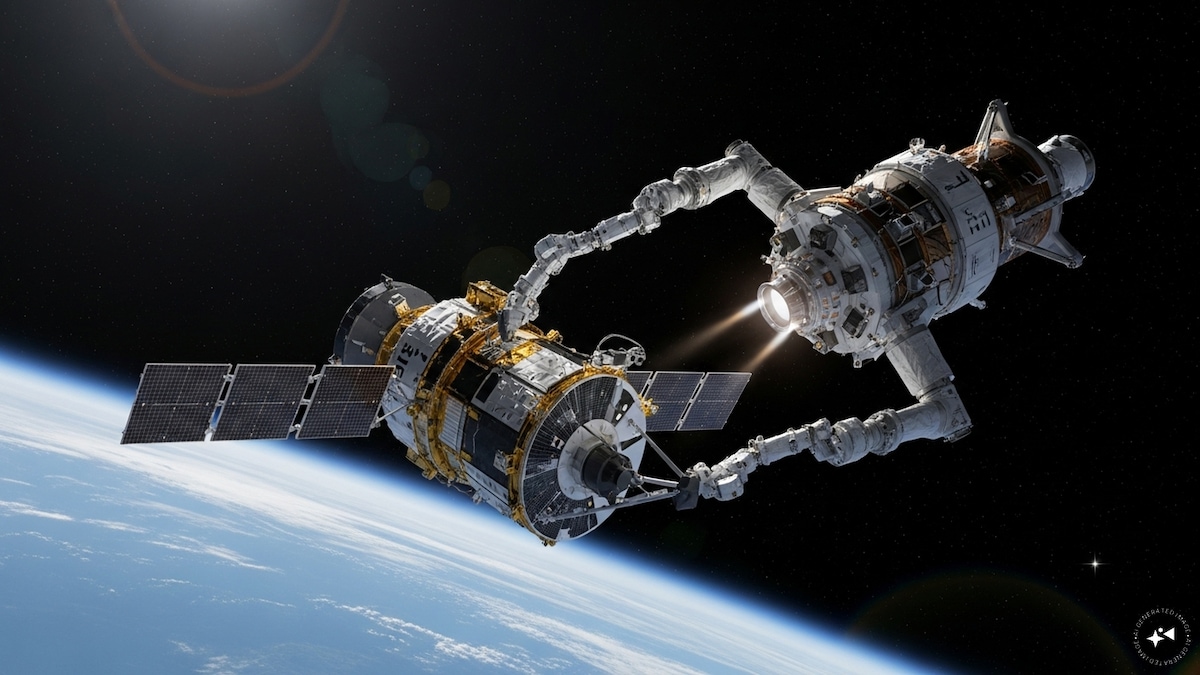
NASA has enlisted the help of startup Katalyst Space Technologies to elevate the Swift Observatory to a safer orbit, allowing it to continue its search for some of the universe’s most significant explosions. A specialized three-armed spacecraft developed by Katalyst will pursue Swift after it launches from a Pacific atoll in the Marshall Islands, using an airplane-launched Pegasus rocket. Liftoff could be as soon as Tuesday.
Since its launch in 2004, Swift has been descending increasingly due to recent high solar activity. It urgently requires a higher, more stable orbit to survive.
NASA’s Hubble Space Telescope — which also faces risks — could be next in line.
Like Swift, Hubble is gradually losing altitude as the sun unleashes a series of flares. Katalyst Space CEO Ghonhee Lee mentioned that a next-generation robot, still under development, might be able to rescue the larger Hubble in a couple of years.
Only China has previously attempted a mission like this, successfully moving a satellite to a higher orbital position four years ago.
“This is the first American space robot to undertake a mission like this,” Lee told The Associated Press. “NASA has numerous significant observatories that could benefit from such services. What we’re demonstrating with this mission is a new strategy that could be employed.”
It will take Katalyst’s autonomous spacecraft, named Link, approximately a month to rendezvous with Swift and capture it, followed by a couple of months to elevate its orbit from the current 224 miles (360 kilometers) to the targeted 373 miles (600 kilometers).
The 1.6-ton (1.4-metric ton) gamma-ray observatory must exceed an altitude of 185 miles (300 kilometers) for the rescue operation to succeed, and it is projected to reach this critical point in October, according to recent estimates.
Link, comparable in size to a small kitchen refrigerator and equipped with a 40-foot (12-meter) solar wingspan, has three arms extending just over 3 feet (1 meter) each. Each arm features two finger-like grippers that resemble the hands of a Lego mini figure.
If successful, Swift could be operational again by September, according to Lee.
Valued at hundreds of millions, Swift was not originally designed for repairs, making the endeavor particularly challenging, as noted by company officials who emphasize that success is not guaranteed.
Nine months after signing a contract with Katalyst last September, NASA is set to proceed, with just two stipulations: the operation must be expedited, but it must not worsen the situation. The company is ready to move forward.
“To be frank, no one believed it would be feasible. No one thought we would progress as far as we have today,” remarked Shawn Domagal-Goldman, NASA’s astrophysics director.
NASA has managed to buy some extra time for Swift by deactivating all scientific instruments to slow its descent, halting observations in February.
NASA’s science mission chief, Nicky Fox, expressed that the effort is worthwhile.
“If we allow Swift to re-enter, we would lose that telescope and a lot of capabilities,” she stated. “Our current budget does not allow for building a replacement.”
While not everything in space can be saved, Swift holds a special significance, according to Domagal-Goldman.
True to its name, Swift is engineered to quickly pivot to capture urgent astronomical events like gamma-ray bursts and supernovae. With the Webb Space Telescope and the upcoming Roman Space Telescope set to drive further discoveries, if rescued, Swift would be busier than ever as “NASA’s first responder.”
Katalyst envisions Swift as the starting point for a new repair industry in space. Its next-generation robotic rescuer, planned for launch next year, aims to service satellites at altitudes up to 22,300 miles (35,800 kilometers). Lee envisions a future with hundreds of robots in orbit, tasked not only with mending and lifting satellites but also with refueling them and constructing solar farms, data centers, and other facilities.
The 36-year-old Hubble, which received multiple servicing missions through spacewalks during the shuttle era, may also receive a life-extending boost from Katalyst by 2028.
“It’s a national treasure,” Fox remarked. “People adore Hubble.”