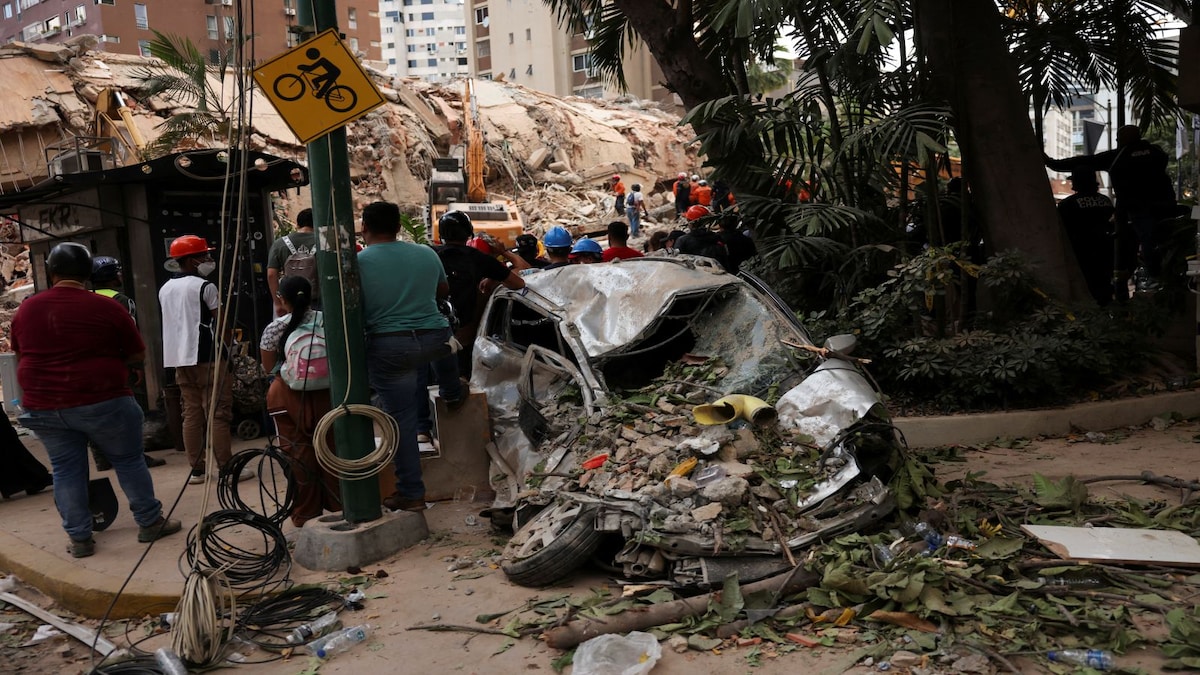
The US Geological Survey (USGS) reported that the initial earthquake registered a magnitude of 7.2, while the subsequent quake, with a magnitude of 7.5, hit merely 39 seconds later.
What Is an Earthquake Doublet?
A doublet is defined as two strong earthquakes of similar magnitude occurring closely in time and space.
Unlike standard earthquakes, where a stronger quake is usually followed by smaller aftershocks, a doublet consists of two significant seismic events that are distinct from one another. Although interconnected, each earthquake emanates from different origins and generates its own seismic waves.
The USGS indicated that the first quake struck near San Felipe, the capital of Yaracuy state, while the second, more intense quake occurred near Yumare just 39 seconds later.
Are Doublets More Dangerous?
Doublets pose a greater risk than typical earthquakes because they involve two similarly powerful quakes occurring in rapid succession. This can lead to amplified destruction, as people have minimal time to recover from the initial tremor. In the case of Venezuela, the second quake began to shake before the first had fully dissipated.
“Double earthquakes are highly destructive. The key difference is that double earthquakes possess comparable energy, while a single earthquake followed by smaller aftershocks generates lesser energy,” Raul Perez-Lopez, an earthquake scientist at Madrid’s Geological and Mining Institute of Spain, told CNN.
Why Are Doublet Earthquakes So Rare?
While relatively uncommon, earthquake doublets do happen. A notable recent instance occurred in Turkey and Syria in 2023, where two significant earthquakes with magnitudes of 7.8 and 7.7 struck approximately nine hours apart. Another example is the 1988 Tennant Creek earthquake series in Australia, which featured a triplet of strong earthquakes occurring within just half an hour.
Why Is Venezuela Prone To Earthquakes?
Venezuela is situated along the boundary between the Caribbean Plate and the South American Plate, where these plates continuously slide against each other in the northern regions of the country. They shift at a rate of roughly 20 millimeters annually.
This tectonic activity creates large strike-slip faults, making the area susceptible to frequent, often shallow earthquakes, some of which can be quite damaging. Historically, the country has experienced several major seismic events, including the powerful 7.7 magnitude earthquake in Caracas in 1900 and another significant quake in 1967 measured at 6.5.
(Edited by : Priyanka Deshpande)