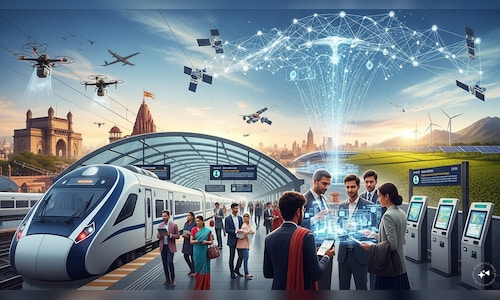
To further explore how India navigates, decides upon, and engages in travel within a closely-knit ecosystem, we present key insights from an engaging panel discussion titled ‘Skyscanner presents transforming India’s travel future – technology, partnership, and innovation’ in collaboration with CNBC-TV18.
This article compiles valuable perspectives from industry leaders who are at the forefront of this transformation within the travel ecosystem. The distinguished panellists include Neel Ghose (Country Manager and General Manager, Skyscanner), Govind Bansal (Head of Marketing, Cleartrip), and Sagar Naik (Vice President, Commercial and Sales, Akasa Air).
Inside India’s Travel Ecosystem
The travel scene in India is undergoing significant changes, primarily driven by the expanding middle class and increasing disposable income. New travel behaviours are emerging that are notably altering how Indians search for and plan their trips.
In this context, Neel Ghose from Skyscanner highlights the two most significant trends currently influencing traveller behaviour. He notes, “The primary trend we observe is the growing aspirations for international travel among Indians. Despite various economic and operational uncertainties, Indian tourists are increasingly leaning towards international vacations. Three years ago, 80% of Skyscanner searches were for domestic travel, while only 20% were international. Today, outbound travel has surged significantly, with 51% of Skyscanner searches being domestic and 49% international. The second crucial trend is the rise of travel premiumisation among the newly affluent Indian population. Today’s travellers seek experiences beyond mere cost, willing to invest more for enhanced experiences, comfort, and tailored offerings.”
These trends showcase the evolution of Indian travellers from being price-sensitive to becoming more experience-oriented and globally aware, reshaping the travel industry’s landscape in the country.
Govind Bansal from Cleartrip provides further insight into the evolving decision-making processes of Indian travellers. He explains, “Current travellers are more intention-driven. They frequently don’t have a specific destination in mind. Instead, they commence their journey with a specific mood, timeframe, and budget, relying on platforms to compare and discover suitable options.” He further adds, “Today’s travellers prioritize value over the lowest prices, focusing on quality, convenience, and return on investment from experiences rather than merely lower costs.”
Another notable travel trend that has surfaced is the burgeoning travel demand from beyond metro cities. Sagar Naik from Akasa Air observes, “Cities in Tier-2 and tier-3 India have become critical drivers of travel demand. We are witnessing a significant influx of first-time flyers in India, with unprecedented numbers taking to the skies.”
Partnerships Powering Seamless Travel Journeys
Travel today is increasingly interlinked, with ecosystem partners collaborating to create fluid customer journeys. Through strategic alliances and integrated technology, these platforms facilitate smooth transitions for travellers, from inspiration and planning to booking and experiences, leading to a more personalized and interconnected travel journey. Govind Bansal from Cleartrip acknowledges the company’s deep investments in ecosystem partnerships to ensure a seamless travel experience for customers.
Sagar Naik from Akasa Air remarks, “Collaborating with metasearch travel platforms like Skyscanner, which boasts a database of over 160 million customers, grants us substantial visibility and access to precious traveller insights. By closely analyzing emerging demand trends, we can anticipate future travel behaviours and strategically expand routes and sectors with substantial growth potential in the years ahead.”
Technology Driving India’s Travel Evolution
Technology is revolutionizing the travel experience by making discovery, planning, booking, and personalization faster, smarter, and more seamless than ever before. Particularly in India, the adoption of AI in travel is notably more prevalent than in other parts of the world. Skyscanner’s 2026 travel trends research indicates that 86% of Indian travellers feel confident using AI for travel planning, compared to a global average of 54%.
Neel Ghose from Skyscanner shares, “We are harnessing AI technologies to enhance travel discovery, making it more intuitive, personalized, and seamless for modern travellers. Additionally, our partnership with OpenAI allows us to embed our flight search capabilities directly into ChatGPT across 66 global markets, enabling customers to plan trips, compare rates, and obtain personalized travel recommendations through conversational AI rather than traditional search mechanisms.” For further insights, please check out the panel discussion video. Click here to download the Skyscanner app.
Challenges Across Travel Ecosystem
As India rises as a global travel nexus, challenges such as price volatility and uncertainty persist. Addressing these issues is essential for building trust. Navigating these obstacles requires transparency and a collective focus among ecosystem partners.
Neel Ghose from Skyscanner emphasizes, “Sharing real-time data enables travellers to make more informed decisions, ensuring an optimal travel experience.” Sagar Naik from Akasa Air and Govind Bansal from Cleartrip also underscore that collaborating within the ecosystem helps to alleviate price friction and enhance the travel experience for customers.
Wrapping Up
Today, India stands as not just a growth market but a redefining force in global travel. Advanced technology, collaborative ecosystems, and a profound understanding of modern travellers’ aspirations converge to deliver a seamless travel experience.