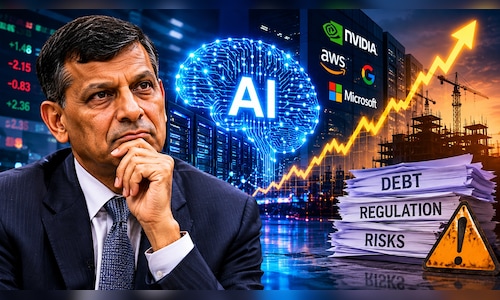
In a recent essay for Project Syndicate titled ‘A Cold Shower for AI Mania’, Rajan recognized the transformative capabilities of AI tools, pointing out that large language models can already generate referee reports on academic papers that often rival those authored by humans.
“Human reports are seldom superior,” Rajan stated, indicating that AI systems can detect analytical flaws, verify proofs, and propose enhancements by quickly referencing a vast array of literature.
Also read: The drone market is about to go parabolic because of AI and war. How to play it
Despite these advancements, Rajan expressed concerns about the “market euphoria surrounding AI,” especially due to the substantial debt incurred to fund investments in the sector.
He pointed out that risks are prevalent throughout the AI supply chain, affecting chipmakers, infrastructure providers, data centers, AI model developers, and end users alike.
While personal adoption is accelerating and corporate use is rising in areas like software development and customer support, many large firms are still in the experimental phase with AI rather than fully implementing it across their operations.
According to Rajan, companies face a variety of challenges, including organizing historical data, integrating AI into existing workflows, concerns over data security, and the potential for errors or hallucinations that could harm their reputations.
He also warned that today’s AI infrastructure might become outdated sooner than anticipated if chips evolve to be significantly more efficient, complicating the ability of data-center operators to recuperate their investments. Meanwhile, he cautioned that the rapid progress in large language models could eventually reach a plateau until a new technological breakthrough is made.
Also read: Maharashtra to set up six AI centres, make 2,000 GPUs to meet computing demand: Fadnavis
Rajan challenged the notion that a single AI model will ultimately dominate the market and generate remarkable profits. He argued that even if a model can self-improve, competitors could catch up. “So far, no AI model appears to have acquired a sustained advantage,” he wrote.
The economist also anticipates increased government scrutiny of the sector. As data centers consume more electricity and elevate power demands, political pressure to limit their growth is likely to intensify. He highlighted instances in Indiana where certain counties have imposed bans on data-center construction.
Beyond infrastructure issues, he cautioned that harmful applications of AI—ranging from cyberattacks and deepfakes to unsafe interactions involving children—might trigger calls for stricter regulations and greater accountability for AI developers. He proposed that dangers associated with rogue AI could potentially lead to international discussions akin to an “AI Geneva Convention.”
Another significant factor that could prompt political action, Rajan noted, would be massive job losses linked to AI adoption. Concerns about social and political backlash might make companies hesitant to reduce workforce size aggressively, ultimately slowing AI-driven changes.
Given these uncertainties, Rajan stated that it remains unclear how swiftly AI will be adopted and which players in the ecosystem will really benefit. While the long-term potential of AI is still acknowledged, he warned that expectations of rapid and extraordinary profits may be unrealistic.
“The good news is that a more cautious and limited rollout of AI could allow firms more time to explore labor-augmenting (instead of labor-displacing) applications,” Rajan remarked. “The bad news is that overly optimistic visions of quick, exceptional profits could be misplaced.”
He concluded by asserting that while AI advancements are likely to pay off in the long run, not every enterprise in the sector will emerge victorious. “AI advancements will likely yield benefits eventually, though not every provider will prosper or even endure.”