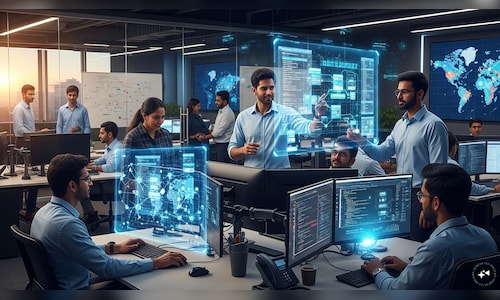
This transition signifies a fundamental change in how multinational corporations leverage their operations in India, evolving from cost-driven support roles to centres that manage core functions including engineering, product development, and analytics.
At Daimler Truck’s Bengaluru facility, the company is internalizing the development of essential software and performance-critical algorithms, according to Radhakrishnan Kodakkal, head of its innovation centre in India.
The automaker emphasizes maintaining internal control over areas that offer a “competitive” edge, particularly software that directly impacts vehicle performance and safety, he mentioned.
Daimler Truck plans to retain activities it views as core and ongoing, while outsourcing functions that vary on a project basis.
US retailer Target, employing over 5,000 staff in India, heavily relies on its internal teams.
“We conduct the vast majority of our tech in-house already,” stated Target India head Andrea Zimmerman, adding that external partners mainly “provide flexibility.”
IN AI THEY TRUST
While cost advantages initially fueled the expansion of India’s global capability centres, AI is now influencing how far these centres ascend the value chain, enabling companies to manage more work internally without proportional hiring.
At IBM, automation has enabled the company “to achieve significantly more with the same team,” said Sandip Patel, head of India operations.
The transition is also apparent in the global distribution of work.
Danish pharmaceutical firm Novo Nordisk’s Bengaluru centre is increasingly involved in global drug launches, undertaking more preparatory tasks, such as for its recently introduced oral obesity pill in the United States.
“A substantial share of the work for any market (launch) will be conducted out of the India centre. There’s likely not a medicine launched globally that hasn’t been touched by Bengaluru,” remarked John Dawber, managing director for global business services.
Enterprise software company Workday noted that its India teams are taking on greater responsibilities for end-to-end product delivery instead of focusing solely on individual modules, indicating a shift away from fragmented, outsourced work models.
US retail group Catalyst Brands mentioned that companies are also increasing investments in internal talent.
“Most market players … are investing in in-house talent to build capabilities,” stated Nihar Nidhi, Catalyst’s India managing director.
Even among companies that continue to engage vendors, the dynamics are changing. Rather than relying on long-term outsourcing contracts, partners are now increasingly sought for specialized skills or quicker execution, while maintaining strategic ownership internally.
Executives noted that this trend is still developing and is unlikely to completely eliminate outsourcing. However, as AI minimizes routine tasks and heightens the importance of speed, control, and integration, global companies are steadily broadening their in-house capabilities.
“Essentially, we can accomplish significantly more with the same group of people due to the advantages AI provides,” said Epsilon India Managing Director Pratik Nath.