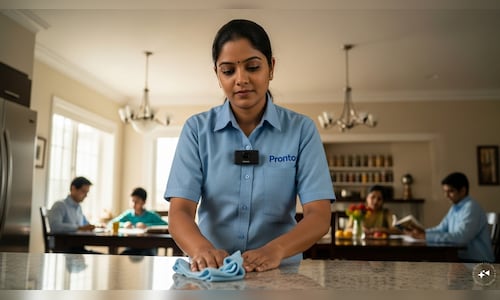
The issue came to light when X user Harsh Upadhyay alleged that Pronto employees were utilizing small outward-facing cameras during select opt-in service visits. He referenced an internal memo from investor Glade Brook Capital, which indicated that Pronto is generating real-world data for physical AI and robotics systems.
Important: How Pronto is turning Indian homes into training grounds for its investors’ Physical AI vision
Did you know? Pronto professionals use small outward-facing cameras during select opt-in jobs, and customers receive the footage afterward.
=> In an internal memo, Glade…
— Harsh Upadhyay (@upadhyay_harsh1) May 22, 2026
Physical AI refers to AI systems integrated into machines and robots that handle real-world tasks like cleaning, cooking, and assisting the elderly. Training these systems necessitates vast amounts of real-world behavioral data.
The Privacy Clause
An examination of Pronto’s Privacy Policy has raised concerns regarding the compliance of their practices with India’s Digital Personal Data Protection (DPDP) Act, 2023.
The policy claims, “in some circumstances, we may aggregate your personal data for research or statistical purposes, in which case we may use this information indefinitely without further notice to you.”
However, it fails to clarify what “research” entails, who will have access to the data, or the necessity of indefinite retention.
Legal experts highlight that under the DPDP Act, consent must be purpose-specific. Consent for services like cleaning or laundry is legally distinct from consent for AI training or indefinite research usage.
This issue was initially reported by Entrackr on May 22, stating that Pronto had been testing cameras during service delivery to generate research data. Documentation reviewed by the publication suggested the company was collaborating with physical AI and robotics labs.
What Pronto Said
Pronto later clarified on X that workers only use cameras during specific opt-in jobs. “Unless you have opted in and paid for the program personally, the Pro doesn’t come to the house with a camera,” the company stated.
Unless you have opted-in and paid for the program personally, the Pro doesn’t come to the house with a camera. Opt in is not one time, it has to be affirmed before each booking. By default there is no camera involved, and when there is, it’s impossible to miss. The pilot reaches… https://t.co/Fqnw76Mk4N
— Pronto (@withpronto) May 24, 2026
The company asserted that consent must be reaffirmed before each booking and claimed that the pilot currently affects only 0.1% of customers. It also noted that faces and identifiable details are automatically obscured, no personal information is uploaded or shared, and footage is deleted within 48 hours.
Nevertheless, questions persist regarding whether workers are made aware that recordings could be utilized for research beyond quality assurance and if they are compensated separately for data collection.
The controversy has also impacted at least one user, who alleged that her Pronto account was restricted after she publicly questioned the company’s practices on X.
Founded by 23-year-old Anjali Sardana, Pronto launched in May 2025, offering on-demand household services such as cleaning, mopping, laundry, and meal preparation. The company claims to currently manage around 18,000 bookings daily.
Pronto secured its Series A funding round in August 2025 and reportedly concluded its Series B round in March 2026 at a valuation exceeding $100 million.
Rivals Push Back
Pronto’s competitors have openly distanced themselves from similar practices. Urban Company co-founder and CEO Abhiraj Singh Bhal stated that the company does not record activities inside customers’ homes and has no plans to implement such systems.
In light of recent reports regarding recordings inside customers’ homes by one of our competitors, many people have asked whether @urbancompany_UC engages in anything similar, or intends to do so in the future.
The answer is clear and unequivocal: we do not.
We are in the…
— Abhiraj Singh Bhal (@abhirajbhal) May 24, 2026
Snabbit’s founder Aayush Agarwal also stated that his company has never recorded customers’ homes, even though they have been approached by others exploring such technology.
Since this morning, people have reached out asking whether @just_snabbit does anything similar to the recent reports about a competitor recording inside customers’ homes.
The answer is clear and unequivocal: We do not.
No customer’s home has ever been recorded by us, in any…
— Aayush Agarwal (@Aa_Agarwl) May 24, 2026
The controversy has placed Pronto at the center of a broader debate concerning AI data collection, informed consent, and the use of private homes as environments for training physical AI systems.
CNBC-TV18 has reached out to Pronto for comment and will provide updates when the company responds.