Puri noted that this visit is timely, following India’s landmark free trade agreement with the European Union signed earlier this year.
“This outreach is crucial as we aim to operationalize the EU FTA,” Puri remarked, highlighting that this agreement has “game-changing potential for India.”
According to Puri, the European Union remains one of India’s vital economic allies, being a significant investor and one of its largest trading partners. He emphasized that engaging not only Germany and France, but also influential European nations like the Netherlands, Sweden, Norway, and Italy, signifies a wider strategic transformation.
“We are already the fifth-largest economy, and nothing can stop us from becoming the third-largest economy, surpassing all other European economies,” he asserted.
Puri observed that Europe’s perspective towards Asia is shifting, with countries increasingly considering India as a rising economic power beyond China. He believes that stronger ties with Europe will promote “multipolarity and multi-alignment in the global context.”
The former diplomat stressed the significance of technology partnerships with Europe, particularly in semiconductors, pharmaceuticals, and advanced manufacturing. He cited the COVID-19 pandemic, noting that RNA vaccines were initially developed by a German company before widespread commercialization.
“Their expertise in semiconductors and high technology is remarkable,” he stated, mentioning that leading Indian firms such as Tata Consultancy Services, Infosys, and Wipro already have a substantial presence in Europe.
Prime Minister Modi’s European tour commenced after his visit to the UAE, where key energy and infrastructure agreements were signed amid rising global uncertainties regarding the Strait of Hormuz. Puri emphasized that the Gulf partnership is central to India’s energy security approach.
“Given the current situation with the Strait of Hormuz, reaching out to alternative options is vital,” he said.
He also connected this outreach to the India-Middle East-Europe Economic Corridor (IMEC), introduced during India’s G20 presidency, designed to enhance connectivity between India, the Gulf region, and Europe via multimodal transport networks.
After concluding his UAE visit, Modi went to the Netherlands for discussions on trade, investment, semiconductors, renewable energy, and geopolitical issues, including the conflicts in Ukraine and Iran. India and the Netherlands finalized 17 agreements, including a semiconductor partnership featuring ASML and Tata.
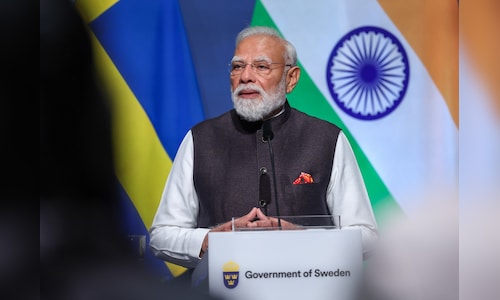
In Sweden, the talks revolved around innovation, sustainability, and research and development. Modi also engaged with leaders from major global companies like Vodafone, Nokia, Shell, Airbus, Volvo, Maersk, Nestlé, and Unilever.
Puri hailed Sweden as a “powerhouse economy” despite its smaller size and pointed out that Swedish firms have historically made a “game-changing contribution” in India.
Modi then traveled to Norway for the India-Nordic Summit, marking the first visit by an Indian Prime Minister to the country in over 40 years. Discussions are anticipated to center on green technology, defense, supply chains, the blue economy, and space collaboration.
Puri indicated that Norway’s significance goes beyond bilateral relationships, noting that its sovereign wealth fund ranks among the largest globally and is actively seeking investment opportunities in India.
“This is about reaching out across the board, not just to major players like France and Germany, but also to Northern Europe,” he remarked.
During his Oslo visit, Prime Minister Modi received the Grand Cross of the Royal Norwegian Order of Merit, the highest honor available. Leaders from Denmark, Finland, Iceland, Norway, and Sweden participated in the summit, with India-Nordic trade expected to hit $19 billion by 2024.
The final segment of Modi’s tour will lead him to Italy for discussions with Italian Prime Minister Giorgia Meloni, aimed at enhancing trade and investment relations following the India-EU FTA.

Also Read | PM Modi says India-Europe ties entering ‘golden age’ as Norway pledges $100 billion investment
Puri described Italy as a “powerhouse” and key G7 member, indicating that India’s collaboration with Rome encompasses sectors like defense, chemicals, and water management. He emphasized that countries such as Italy, Sweden, and the Netherlands are vital to India’s long-term strategy in Europe.
“The message we are conveying since signing the FTA is that we are ready for international business,” Puri concluded.