Sagility’s AI-led transformation initiatives and emphasis on business outcomes are propelling deal momentum, with expectations of double-digit client growth following the addition of 17 clients in 2025-26 (FY26).
Despite ongoing investments in AI and technology, the adjusted margin for FY27 is projected to be between 24-25%.
Sagility is also exploring acquisition opportunities centered on AI capabilities and market access, with a few active deals currently undergoing due diligence, he noted.
Profit growth is likely to outpace revenue as debt repayment in FY27 is projected to facilitate quicker earnings growth. He also mentioned the possibility of achieving a 15% return on capital employed by FY28.
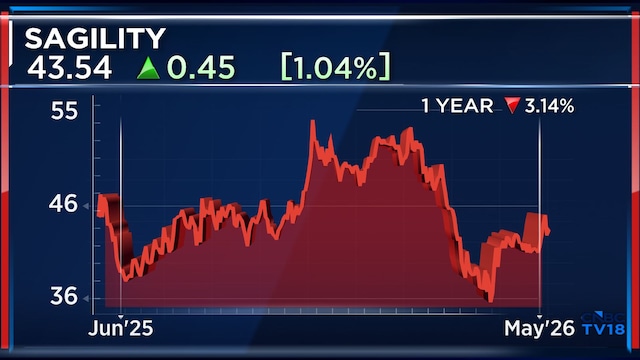
Sagility disclosed its earnings for the January-March 2026 quarter of the financial year 2025-26 (FY26). The company currently holds a market capitalization of ₹20,387.19 crore, with shares declining over 3% in the past year.
This is an edited transcript of the interview.Q: You are forecasting mid-teens constant currency growth for the upcoming year with EBITDA margins of 24% to 25%. Can you share what factors contributed to your topline guidance? How much of the existing pipeline of $570.5 million do you expect to convert? When will the remaining come in, and what will enable you to push margins above 25% structurally?
A: We’ve guided to a low double-digit forecast for FY27. As I previously mentioned, there are significant changes occurring in the US healthcare industry. Cost pressures are prevalent due to medical utilization and regulatory shifts, prompting clients to seek operational cost reductions, a space where Sagility excels due to our deep domain expertise. Our transformation efforts, led by AI, and commitment to business outcomes position us well for growth, which is reflected in our guidance.
Regarding margins, we’ve projected adjusted EBITDA margins of 24% to 25%. A variety of factors influence this, such as salary increments and increased investment in technology and AI, along with some uncertainty in foreign exchange. If forex remains stable, we believe we can maintain towards the upper end of that range.
For the full interview, watch the accompanying video

Q: Could you provide additional details? What new client addition are you anticipating for this year? If you can share the revenue per employee figure — last year, it increased by almost 4%. What is the expected growth? And, if there’s a number for overall employee additions, could you share that?
A: Regarding employee growth, it largely depends on the geographic distribution of our services. Since we operate across various geographies, the revenue structure will impact revenue per employee. Moreover, advancements in technology and AI will enhance employee productivity, contributing to an increase in revenue per employee.
It’s challenging to provide an exact figure for the increase in revenue per employee, but we anticipate a continued upward trend.
On the client addition side, we typically onboard around 8-10 clients annually, which has seen an uptick in the past few years. Following the addition of 17 clients in FY26, we expect to maintain double-digit client growth.
Also Read | Nazara Tech targets a 25% margin by the end of FY27 as the Bluetile deal and AI propel growth
More importantly, the nature of our engagements is evolving. We’re moving away from effort-based work towards a stronger emphasis on end-to-end accountability for business outcomes. Clients are increasingly seeking partners who can assist in transforming operations and achieving overall cost reductions. Hence, we expect to continue with double-digit client additions.
Q: I wanted to ask you, as there is speculation about possible inorganic growth, and given that you have shown interest in that area. Are there deals expected to close in the first half of the year?
A: We are continuously assessing potential deals, so it’s hard to provide a specific timeline. However, we do have a couple of active deals currently in progress. Depending on the due diligence progress, we may be able to close these in the first half of the year.
In terms of deal nature, as mentioned earlier, we’re focused on capability enhancements that align with our transformational objectives — particularly in technology and AI, along with acquisitions that improve market access. We currently have a few deals under active due diligence.
Q: On one hand, you anticipate double-digit client additions. However, increasing revenue from existing clients is also crucial. Your top five clients account for nearly 70% of your revenue, with a potential 40% upside from client two and an 80% to 90% upside from clients three, four, and five. Have you received feedback from them regarding upsizing contracts, and when can we expect further updates on that?
A: We’re consistently collaborating with our top clients to identify opportunities for expansion.
As previously mentioned, our top five clients grew by 11.7% year over year in FY26. These clients make up 70% of our revenues, with an average tenure of 18 years. We are continuously exploring growth opportunities with them and are focused on penetrating the mid and small market for aggressive growth alongside our existing clients.
Also Read | Canara Bank states that asset quality remains stable and can absorb a ₹10,000 crore ECL impact
Q: Final query before we conclude. The return ratios have shown improvement. Notably, your RoCE is in the low double digits now, but the market believes it could reach 15%-16% by FY28. Is that feasible? Some brokerage notes project around ₹1,500 crore in net profit for FY28. Is that along the right lines?
A: Our growth has been significant over the past few years. We plan to eliminate our entire debt burden by FY27. Consequently, profits are expected to grow faster than revenue. Although it’s difficult to provide a precise figure for FY28, we remain optimistic about bottom-line growth.
Q: The return ratio has improved by approximately 100-200 basis points.
A: Yes, that’s correct.
Q: A 15% RoCE — is that within reach?
A: Yes, that is possible.
Catch all the latest updates from the stock market here