In an August 2024 lawsuit, Musk accused Altman and OpenAI of coaxing him into contributing $38 million, only for the nonprofit to abandon its mission of benefiting humanity in favor of becoming a for-profit entity.
As the trial enters its third week, it may shape the future of OpenAI and its leadership, particularly as the company gears up for a potential initial public offering that could evaluate the business at $1 trillion.
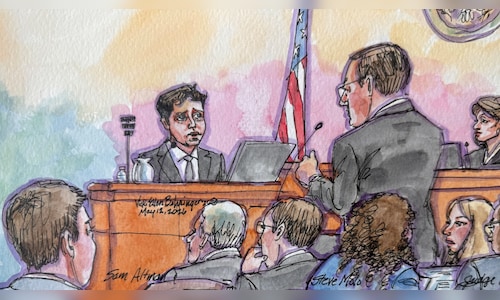
While being questioned by his attorney in the federal court in Oakland, California, Altman refuted Musk’s claim that he and OpenAI President Greg Brockman, also a defendant, attempted to “appropriate a charity.”
Altman remarked, “it’s challenging to even comprehend that framing,” expressing hope that “as OpenAI continues to thrive, the nonprofit will also flourish.”
Musk’s legal team has portrayed Altman as deceitful regarding his intentions for OpenAI.
Musk stated early in the trial: “If you have someone who is not trustworthy overseeing AI, I think that’s a significant danger for the entire world.”
This trial represents a confrontation among tech leaders, with Musk positioning himself as a protector of ordinary people against the risks of artificial intelligence, in contrast to Silicon Valley moguls who prioritize profits.
Musk, the wealthiest person globally, is pursuing approximately $150 billion in damages from OpenAI and Microsoft, a significant investor, to be directed to an OpenAI nonprofit. He also seeks the removal of Altman and Brockman from their positions.
ALTMAN RESISTED MUSK’S CONTROL BID
OpenAI was co-founded in 2015 by several entrepreneurs, including Musk and Altman.
The organization contends that Musk was aware of the for-profit strategy prior to his departure from its board in 2018, and his lawsuit stems from his regret over missing potential financial gains.
OpenAI established a for-profit subsidiary in March 2019.
When questioned by his lawyer William Savitt about Musk’s opposition to the for-profit model, Altman replied “quite the opposite.”
Altman recalled that Musk once demanded a 90% ownership of OpenAI, and he felt “extremely uncomfortable” with relinquishing majority control, even as Musk softened his demands.
“I had considerable experience with startups and witnessed many control disputes,” he noted, referencing Musk’s SpaceX as an example where founders of successful companies consolidated authority to maintain control.
Furthermore, Altman stated that while he and other OpenAI leaders aimed to keep a positive relationship with Musk, he resisted a merger with Tesla, Musk’s electric vehicle company.
“I don’t think we would have been able to ensure that (our) mission was upheld,” he explained. “Essentially, Tesla’s focus is on serving its customers and selling cars.”
MUSK LAWYER QUESTIONS ALTMAN’S INTEGRITY
During a tense cross-examination, Musk’s attorney Steven Molo scrutinized Altman’s integrity.
He referenced testimony from a former OpenAI board member asserting that Altman nurtured a “toxic culture of dishonesty,” alongside statements from seven former OpenAI officials alleging that Altman was not trustworthy.
“Have you ever misled people during business dealings?” Molo asked Altman.
“I consider myself an honest and trustworthy businessperson,” Altman replied.
“That’s not my inquiry. Have you misled individuals during business transactions?”
“I do not believe so.”
Altman recounted his brief removal from OpenAI in 2023, when its board questioned his transparency and emphasized its mission to benefit humanity.
He mentioned considering not returning and potentially joining Microsoft, but OpenAI held significant importance for him.
“I was prepared to rush back into a burning building to save it,” he stated.
Altman does not directly own equity in OpenAI but holds a stake in a fund that has invested in the company. Molo presented jurors with a document outlining Altman’s investments in various firms, including a $1.7 billion interest in fusion energy producer Helion Energy.
He challenged Altman’s role in negotiating agreements with these companies, alleging potential conflicts of interest.
OPENAI CHAIRMAN ASTONISHED BY MUSK’S OFFER
The trial unfolds after OpenAI procured hundreds of billions of dollars from prominent technology companies and investors to bolster its computing capabilities. Altman confirmed that OpenAI has raised $175 billion from private investors throughout its existence.
Musk’s exit elicited mixed reactions within OpenAI, Altman stated, with some employees concerned it might hinder funding, while others felt relieved to be free from Musk’s insistence that researchers frequently justify their progress.
“I don’t think Mr. Musk comprehended how to manage an effective research lab,” Altman commented. “He had demotivated some of our most pivotal researchers.”
OpenAI’s chairman, Bret Taylor, testified separately on Tuesday that OpenAI received a formal acquisition offer from a consortium fronted by Musk’s rival xAI in February 2025, six months following Musk’s lawsuit.
“I was taken aback,” Taylor declared. “This proposal sought to acquire this nonprofit by a coalition of for-profit investors, which seemed contradictory to the essence of the lawsuit.”
Testimony may conclude this week, with jurors potentially starting deliberations on the defendants’ liability by May 18.
U.S. District Judge Yvonne Gonzalez Rogers, presiding over the trial, will determine any resulting remedies.
In earlier testimony, former OpenAI Chief Scientist Ilya Sutskever mentioned that he spent approximately a year compiling evidence for OpenAI directors regarding Altman’s “consistent pattern of dishonesty,” while Microsoft CEO Satya Nadella characterized his company’s investment as a “calculated risk.”
Other witnesses have included Brockman and Shivon Zilis, a former OpenAI board member and the mother of four of Musk’s children.
Also Read: MSCI Rejig: MCX, Indian Bank make the cut; RVNL, Kalyan Jewellers dropped