Subramaniam, founder and Group CEO of Collective Artists Network, reminisced about their intimate conversation when ‘Khana Khazana’ surfaced. Despite his hesitation, thinking Mehta might dismiss or be irritated by the AI collaboration idea, he proposed they create something together.
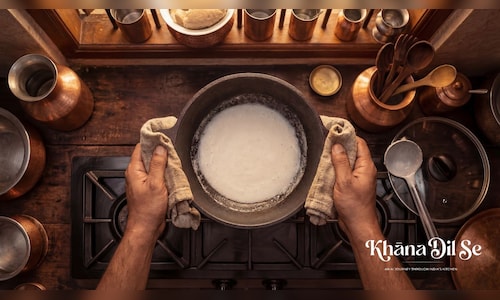
Mehta is re-entering the genre with ‘Khana Dil Se – An AI Journey Through India’s Kitchen’, a new series supported by Collective Artists Network and True Story Films that delves into India’s culinary history, migration narratives, oral traditions, and cultural memories, with AI acting as a “creative collaborator”.
The project also represents Collective Artists Network’s expanding focus on AI-enhanced storytelling and culturally significant intellectual property, including initiatives like its HistoryVerse slate, mythology-inspired ventures, AI-driven influencers, and digital celebrity IP.
For Mehta, AI emerged as an unexpected partner that enabled his return to a genre he once cherished. “So many people suggest I should host a food show. I don’t possess the looks or the constant desire to do that,” he shared. “But I believe I’ve found the ideal partner to make it happen. And that partner isn’t Vijay; it’s AI.”
But what does having AI as a creative partner truly involve?
Also Read: Priyanka Chopra has conquered Hollywood’s spotlight but not its centerstage
According to Subramaniam, the goal is to enhance creators’ capabilities, not to replace them. “A common misconception is that AI is replacive. It’s actually additive,” he emphasized. “The true way to construct a creator-tech platform is to let tech respond to creators rather than the reverse.”
He argues that AI offers creators the chance to minimize logistical hurdles and experiment on a larger scale. “Consider producing a show like this. Preparation typically takes at least 30 days, requiring location scouting, casting, and hiring a crew. Here, the output is quicker — but it wouldn’t exist without human contributions,” he explained.
The Shahid director illustrated AI as a collaborator that extends creators’ boundaries. “AI has liberated me. It reveals ideas I couldn’t envision and exceeds those limits. It challenges me with possibilities I thought were unattainable,” he remarked.
The episodic series uncovers themes of identity and memory through time-honored recipes, marking a full-circle moment for Mehta, who launched ‘Khana Khazana’ in the 1990s, a legendary cooking show that cemented chef Sanjeev Kapoor’s fame.
“I’ve always been connected to the food television realm. Whether through ‘Khana Khazana’ or thereafter, I’ve maintained a relationship with it. It’s an essential part of my life. It’s how I embarked on my filmmaking journey,” Mehta stated.
The filmmaker confessed that, despite transitioning to mainstream cinema, he often yearned for food storytelling. “I experienced periods of FOMO — questioning why I was not engaged with this genre. I’d compensate by cooking myself,” he said.
Also Read: How the first viral video danced its way into internet history and it wasn’t on YouTube
Mehta described recipes as his “love language”, noting that many of his friendships — including with chefs Ranveer Brar and Vikas Khanna — revolve around sharing recipes and culinary stories. Recalling one exchange, he mentioned that Khanna once asked him to watch his film, to which the Scam 1992 maker replied, “Only if you send me a mutton recipe.”
For Mehta, however, the series is ultimately a celebration of food as a cultural repository rather than a focus on technology. “Food unifies us while we are divided by everything else crafted by humankind — be it caste, religion, or class. We may differ in many areas, but we are consistently united by food,” he conveyed.
He noted that technology has enabled him to experiment visually in ways that traditional filmmaking could not. He highlighted scenes where the audience feels part of the cooking process, a feat he claims wouldn’t have been achievable with conventional filming methods.
“The audio-visual medium is two-dimensional. It offers the illusion of immersion, but cannot provide the ability to smell or touch adequately. This technology is facilitating my quest for deeper immersion. How can I almost smell the food?” he pondered.
While both expressed enthusiasm for AI, Mehta recognized that the technology also brings forth unresolved creative and ethical dilemmas. “We haven’t yet perfected the collaboration between humans and machines in this age of artificial intelligence,” he pointed out. “Numerous ethical questions continue to arise.”
Nonetheless, the filmmaker likened the current AI evolution to past technological advancements in cinema. “When I directed my first film, Anurag Kashyap wrote that script by hand. Years later, we began using Final Draft for screenwriting. Did the scripts improve because of that? Not really. We simply honed our writing skills,” he recalled. “Ultimately, the artist remains paramount.”
Also Read: More About Marilyn: Last big interview, Arthur Miller tapes turn spotlight back on Hollywood icon
Subramaniam believes AI could democratize storytelling, empowering younger creators to experiment with fewer constraints. “AI is the new technology. It’s the new internet,” he stated. “If we can help ensure that anyone with a story vision has the resources to share it, that’s a victory.”
In an era where discussions around entertainment often focus on dwindling attention spans and algorithmically driven content, both Mehta and Subramaniam dismissed the notion that audiences lack the patience for immersive storytelling.
“I disagree with the whole attention span theory. I believe there’s an audience for anything that’s compelling,” Mehta asserted. “Even today, the most popular films can be four hours long. What does that indicate about attention span? It suggests that as long as you engage the audience, they are willing to stay.”
Subramaniam concurred, arguing that the current challenge is less about declining attention spans and more about capturing attention in a saturated environment. “It’s not so much about shorter attention spans, but about how to attract attention in a bustling ecosystem,” he said. “If you offer something that the audience desires, they will stay and support it.”
Mehta likened the present AI moment to how the IPL transformed cricket. “Many predicted the IPL would end cricket. In reality, it democratized the sport,” he noted. “The influx of extraordinary young cricketers arising from the IPL demonstrates they no longer need national play to have opportunities.”
“We are on the brink of the creator’s IPL,” Mehta declares. “AI is the Premier League we are approaching.”
The first episode of ‘Khana Dil Se – An AI Journey Through India’s Kitchen’ premieres on May 12 on Terribly Tiny Tales’ YouTube channel