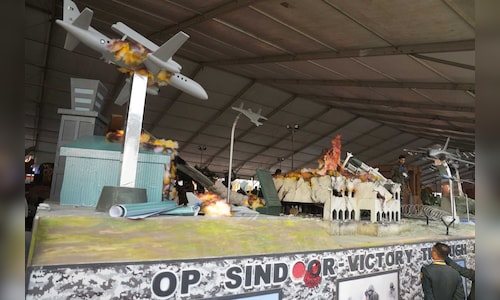
In an interview with CNBC-TV18 to mark one year since Operation Sindoor, Malik noted that recent global conflicts, like the confrontation with Iran and the ongoing war in Ukraine, have underscored the rapid transformation of warfare.
“There is no question that the nature of conflict has shifted,” Malik remarked. “Given the array of new technologies and weapon systems at our disposal, it’s clear that drones will likely assume a far more prominent role moving forward.”
Operation Sindoor involved India deploying sophisticated military assets, including fighter jets, beyond-visual-range missiles, BrahMos missiles, and the S-400 air defense system while conducting operations against terror infrastructure in Pakistan and Pakistan-occupied Jammu & Kashmir.
A year ago, India initiated Operation Sindoor following the Pahalgam terror attack that resulted in 26 casualties. The operation targeted nine terror infrastructure sites in Pakistan and Pakistan-occupied Jammu & Kashmir, with the government asserting that the strikes were completed in under 30 minutes.
The Army, Navy, and Air Force worked in coordination during the operation, which the government claimed neutralized key terrorists linked to the IC-814 hijacking and the Pulwama attack.
Following the operation, Pakistan launched retaliatory strikes, to which India responded by targeting 11 Pakistani airbases.
Malik emphasized that a crucial lesson from contemporary warfare is that escalation can occur extremely rapidly, potentially transforming a limited conflict into a high-intensity war in a short time frame.
“Escalation can occur very quickly,” he stated. “It can escalate into a high-intensity battle or conflict with little warning.”
He added that India needs to prepare for both short-term precision conflicts and extended wars similar to the situation in Russia and Ukraine.
“We must be ready not only for short-war scenarios, which took only about 88 hours, but also for prolonged engagements, as evidenced in Ukraine,” Malik mentioned.
The former Army chief pointed out that India’s security landscape has become more complex due to the dual challenges presented by adversaries on both northern and western fronts.
“With adversaries on both the north and west, we must gear up for this type of warfare,” he stated.
Former diplomat Achal Kumar Malhotra noted that geopolitical dynamics are also influencing modern conflicts, with countries increasingly acting in accordance with their strategic interests rather than consistent counter-terrorism positions.
“The Americans have their own motivations in engaging with Pakistan,” Malhotra commented, referring to Washington’s recent outreach to Islamabad.
Also Read | From BrahMos to drones: How Operation Sindoor reshaped India’s warfare
Prime Minister Narendra Modi previously commended the armed forces for delivering a robust response to those responsible for the Pahalgam terror attack, while Home Minister Amit Shah emphasized that India’s enemies cannot evade the nation’s surveillance and military might.
Malik concluded that future military preparedness will necessitate India’s investments in emerging technologies and readiness to respond to rapid escalation scenarios in an increasingly volatile global security landscape.