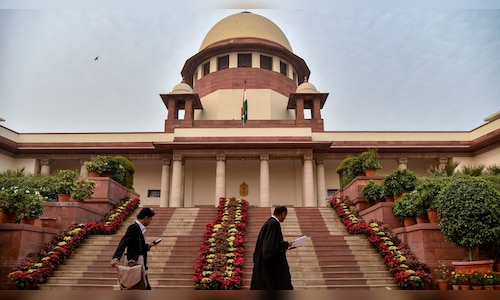
The court acknowledged the Election Commission of India’s (ECI) commitment to fully implement its April 13 circular on the issue. A special bench consisting of Justices PS Narasimha and Joymalya Bagchi reviewed the case ahead of the counting schedule.
“The court found no need for additional orders and reiterated Mr. Naidu’s (for ECI) statement that the April 13, 2026 circular will be executed in good faith,” Live Law reported.
The petition contested an earlier ruling from the Calcutta High Court that dismissed TMC’s concerns regarding the arrangements.
During the hearing, the court noted that TMC representatives would be present at the counting and stated that the ECI’s circular was compliant with existing regulations. Senior advocate Kapil Sibal, representing TMC, questioned the timing and rationale behind the circular, mentioning that it had only recently come to their attention.
“The CEO’s communication indicates various concerns have been voiced regarding potential irregularities in counting… They seek another Central government nominee due to fears of possible irregularities, which suggests distrust in the state government…” Sibal remarked.
On behalf of the ECI, senior advocate DS Naidu defended the arrangement, clarifying that the Returning Officer, a state official, holds overall authority over the counting procedure. He emphasized that each counting table would feature both a state and a Central government representative, labeling the concerns as ‘misplaced apprehensions.’
The bench pointed out that appointing officials as Central government nominees was not an issue, as such decisions are within the Election Commission’s jurisdiction. It also confirmed that multiple safeguards are established, including party-appointed counting agents and micro-observers, who are Central government officers.
“The option remains that the counting supervisor and assistant can belong to either the Central or state government. Given this flexibility, we cannot declare the notification as contrary to regulations. They might even opt for both to be Central. Even if that were the case, it wouldn’t be a violation, as regulations permit appointments from either level of government,” Justice Bagchi stated.
Previously, TMC had approached the Calcutta High Court challenging the assignment of critical counting roles. The party contended that such actions exceeded the Additional Chief Electoral Officer’s authority and strayed from established protocols. They voiced concerns over potential partiality, arguing that Central personnel might be subject to external pressures.
However, the High Court dismissed these claims, declaring that the decision lies within the Election Commission of India’s domain. The court also highlighted the presence of sufficient safeguards, including CCTV monitoring, micro-observers, and counting agents, to ensure transparency throughout the process.