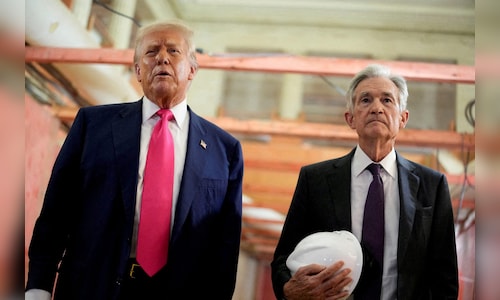
“I worry these attacks are undermining this institution and jeopardizing the aspects that truly matter to the public,” Powell remarked during a press conference following the Fed’s decision to maintain its benchmark interest rate.
Powell’s decision marks the first instance since 1948 where a Fed chair will stay on the board as a governor, denying President Donald Trump the opportunity to appoint someone new to the central bank’s seven-member governing board. The Senate Banking Committee has already approved Trump’s nominee Kevin Warsh as Powell’s successor as chair along party lines. Powell will continue to serve as a Fed governor, potentially until January 2028. Warsh, if confirmed, will occupy a seat currently held by Stephen Miran, another Trump appointee, whose term ended in January.
Economists suggest that Powell’s decision could complicate Warsh’s efforts to implement the rate cuts that Trump has insisted upon and Warsh advocated for last year.
“It likely means that Warsh will require additional time to establish the consensus he seeks,” stated David Seif, chief economist for developed markets at Nomura, an investment bank.
US Attorney for the District of Columbia Jeanine Pirro announced on X Friday that her office was terminating its investigation into the Fed’s extensive building renovations, as the Fed’s inspector general will take over the scrutiny. However, she indicated that her office may reopen the investigation if “the facts warrant doing so.” Pirro had previously mentioned plans to appeal a court ruling that nullified subpoenas her office had issued.
Powell noted on Wednesday that he had received assurances from the Justice Department that the appeal would not lead to a revival of the investigation unless the Fed’s inspector general uncovers evidence of criminal activity.
Apparently, that assurance did not provide Powell with the closure he seeks.
“I’m waiting for the investigation to conclude with clarity and transparency,” he said. “I will depart when I deem it appropriate.”
The Fed left its benchmark interest rate steady for the third consecutive meeting, yet indicated a possibility of rate cuts in the coming months, resulting in the most dissent since October 1992. Three officials voted against the suggestion of eliminating the reference to a future cut, while a fourth, Miran, dissentingly favored an immediate rate cut.
This dissent highlights the division within the Fed’s 12-member rate-setting committee as Powell’s term as chair approaches its conclusion on May 15.
“Developments in the Middle East contribute to a high level of uncertainty about the economic outlook,” the Fed stated following its two-day meeting. “Inflation remains elevated, partly due to the recent spike in global energy prices.”
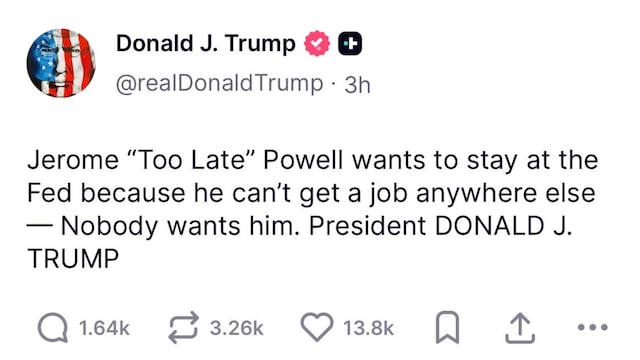
In response to Powell’s decision, Trump posted late Wednesday on his social media platform: “Jerome ‘Too Late’ Powell wants to stay at the Fed because he can’t get a job anywhere else — Nobody wants him,” utilizing his nickname for the Fed chair.
Warsh has promised “regime change” at the central bank and may seek significant alterations in its economic models, communication strategies, and balance sheet. Although he has advocated for rate cuts per Trump’s demands, implementing these may pose challenges with inflation exceeding 3%, above the Fed’s 2% target.
When asked whether he believed Warsh would withstand political pressure from Trump, Powell replied, “He testified very convincingly at his hearing, and I take him at his word.”
The dissenting officials opposing any indication that the Fed may lower borrowing costs included Beth Hammack, president of the Federal Reserve Bank of Cleveland; Neel Kashkari, president of the Minneapolis Fed; and Lorie Logan, president of the Dallas Fed. Regional Fed bank presidents tend to dissent more frequently, whereas the Washington-based governors typically align with the chair.
The dissents could reignite friction between the Trump administration and the bank presidents, who have previously been criticized by White House officials.
Beth Ann Bovino, chief economist at US Bank, remarked that the dissents illustrate the Fed policymakers’ “strong independence” and suggested that they might remain on hold for several more months. She has forecast a rate cut in December but is now uncertain about that prediction. Wall Street investors, on average, do not anticipate a reduction until well into the following year, as per futures pricing.
Powell’s decision to remain could escalate tensions with the Trump administration and create what some analysts describe as a “two Popes” scenario, with both a chair and former chair on the Fed’s board. This situation could heighten divisions among policymakers if some choose to align with Powell rather than Warsh.
Powell dismissed concerns that his continued presence could foster discord, stating, “My intention is not to interfere,” later adding, “I’m not looking to be a high-profile dissident or anything akin to that.”
Nonetheless, Powell expressed ongoing concerns regarding the Fed’s autonomy from the White House, emphasizing its critical role in setting rates that benefit the public, rather than responding to political pressures. Changes in the Fed’s short-term rate eventually influence the costs of mortgages, auto loans, and business borrowing.
Fed independence remains “at risk,” he stated. “We’ve had to rely on legal recourse to ensure our … capacity to conduct monetary policy without political influences. We’ve managed thus far, but that situation has not yet concluded.”
The unusual circumstances arise as the economic landscape remains complex, placing the Fed in a challenging position. Inflation has surged to 3.3%, a two-year high, fueled by the war’s effects on gas prices. This complicates the central bank’s ability to lower rates. Typically, the Fed opts to maintain or even increase rates when inflation is a concern.
Simultaneously, hiring has nearly stagnated, leaving jobseekers frustrated by challenges in securing employment. Generally, the Fed lowers rates when the job market weakens, to stimulate spending and hiring.
However, layoffs remain low, as employers seem to be adopting a “low-hire, low-fire” strategy. Many Fed officials have suggested that with the unemployment rate remaining low, the central bank doesn’t need to lower rates to boost spending or hiring. Unemployment dropped to 4.3% in March from 4.4%.
Also Read: Powell’s final call: Fed holds rates amid sharp divide