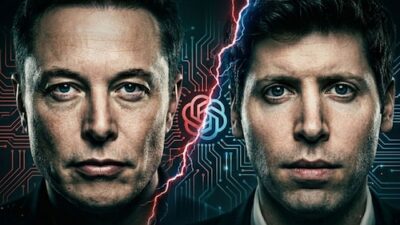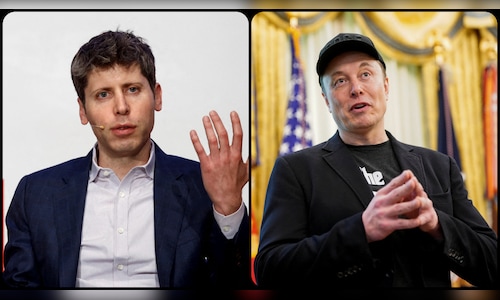
The world’s wealthiest individual was on the stand for a second day in a crucial trial regarding a lawsuit he filed against OpenAI, its co-founder and CEO Altman, and President Greg Brockman. Musk accuses them of abandoning their mission to develop AI responsibly when they established a for-profit entity in 2019.
A nine-person jury in federal court in Oakland, California, viewed an email that Musk sent to Altman and Brockman in 2017, where he called himself a “fool” for funding what he thought was a nonprofit initiative.
“I felt they had not been honest with me,” Musk said during questioning by his attorney, Steven Molo. “What they really aimed to do was create a for-profit entity where they could maximize shareholder control.”
Musk, dressed in a dark suit over a white shirt, occasionally glanced at the jury as he spoke.
Later, he is expected to face cross-examination from a lawyer representing OpenAI, which claims that Musk is driven by a desire to control the company.
OpenAI has stated that it established a for-profit entity to enable the purchase of computing resources and to compensate top scientists.
MUSK ACKNOWLEDGES XAI HAS SMALLER MARKET SHARE
The trial underscores the significant divide between Musk and Altman. The two Silicon Valley figures previously collaborated in developing the rapidly advancing AI sector, which is a key component of growth in the U.S. economy, also raising concerns about job displacement.
The duo co-founded OpenAI in 2015 to serve as a responsible steward of the technology and to compete with other entities like Alphabet’s Google. Musk, the CEO of Tesla and SpaceX, departed from OpenAI in 2018 after investing $38 million. Microsoft, also a defendant, invested $10 billion in OpenAI in 2023.
Musk acknowledged that most tech companies operate for profit but suggested that OpenAI used its nonprofit status to instill public confidence that it was developing AI safely, while allowing its for-profit arm to become the “main event.”
“They shouldn’t profit off a nonprofit; that’s not right,” Musk testified. “They can’t have it both ways—the positive image of a charity while enriching themselves significantly.”
Musk testified that he resigned from OpenAI’s board to concentrate on SpaceX and Tesla, and he stopped funding OpenAI in 2020.
Lawyers for OpenAI and the other defendants contended that Musk aims to promote his AI company, SpaceX’s xAI, which trails OpenAI in user engagement. They also pointed out that AI safety wasn’t a priority for Musk while he was with the company, and he derided employees focused on it as “jackasses.”
When Molo asked if he had ever referred to an OpenAI employee as a “jackass,” Musk replied it was possible.
“I don’t lose my temper. I’m not a yeller. I don’t yell at people,” Musk testified. “Sometimes you must use language that pushes people out of their comfort zone.”
Musk acknowledged during his testimony that xAI has a smaller market share compared to OpenAI.
“At this point, it’s technically a competitor, but much, much smaller than OpenAI,” he said.
MUSK SEEKS $150 BILLION IN DAMAGES
The trial takes place as OpenAI prepares for a potential initial public offering that could value it at $1 trillion, according to Reuters. The company also faces increasing competition from rivals like Anthropic, while a report from the Wall Street Journal highlighted that OpenAI had missed some internal performance targets, impacting the tech-heavy Nasdaq Composite.
Musk is pursuing $150 billion in damages from OpenAI and Microsoft, with any awarded amount designated for OpenAI’s charitable division. He also seeks to revert OpenAI to a nonprofit status while removing Altman and Brockman from their positions, and Altman from the board.
His allegations include breach of charitable trust and unjust enrichment.
OpenAI is currently structured as a public benefit corporation, wherein the nonprofit and other investors, including Microsoft, hold stakes.