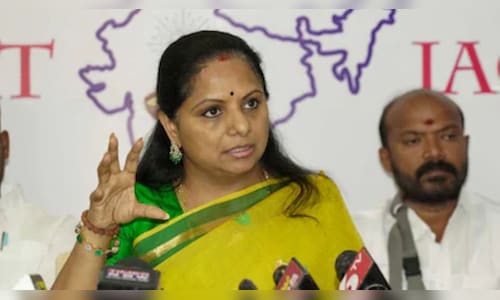
This development has generated significant intrigue. Why would the daughter of a former Chief Minister, whose party remains active, opt to start a separate political entity? This question is being posed not only in political circles but also among the general public. Until recently, Kavitha operated within her father’s political realm, making this shift particularly noteworthy.
A political journey shaped early
Born on March 13, 1978, Kavitha was raised in a politically charged environment. By the time she was seven, her father had already been elected as an MLA from Siddipet on a Telugu Desam Party ticket in 1985. Over the years, KCR cultivated a lengthy political career as an MLA, MP, Minister, and Union Minister.
Kavitha experienced significant events, including the Telangana movement, the establishment of the Telangana Rashtra Samithi, and ultimately, the formation of Telangana. Her close associates assert that this exposure inspired her to forge her own political identity.
While staying affiliated with the BRS, Kavitha often presented herself as someone lacking overt ambition, stating, “We just keep doing our work. I don’t have any special desires.” However, after distancing herself from the party, she has more recently expressed, “I will become Chief Minister—why not?”
From the US to Telangana activism
Kavitha lived in the United States until 2003, where she pursued higher education, got married, and built her career. She returned to India in 2004, coinciding with KCR’s entry into the Union Cabinet.
She swiftly established Telangana Jagruthi, which played a crucial role in the Telangana movement, particularly in fostering cultural identity. Through this organization, she worked to popularize Bathukamma across India and abroad, organizing events in various states and countries.
Also Read: Who is Swarna Kanta Sharma, the judge Arvind Kejriwal wants off his case
A BRS leader told News18, “Kavitha has long felt a sense of resentment… especially over T Harish Rao becoming a minister even before he became an MLA.” The leader added that she returned from the US with political ambitions that didn’t come to fruition at the time, driving her to establish Jagruthi. These comments suggest a long-standing determination to carve out her own niche in politics.
Rise as a national figure
In 2014, Kavitha was elected as an MP from Nizamabad. Known for her fluency in Telugu, Hindi, and English, she garnered recognition in Parliament and served on multiple committees while forging connections with national leaders.
Senior journalist Martha Subrahmanyam remarked to News18, “In some ways, one could argue that Kavitha is more astute than her brother KTR… she established her own identity and gained a reputation as a worthy daughter of her father.”
However, he noted that these connections ultimately “backfired” during the Delhi liquor case, where she spent nearly six months in jail before the case was dismissed.
Setbacks and fallout
After her loss in the 2019 Lok Sabha election from Nizamabad, Kavitha faced considerable backlash. She was later elected as an MLC in 2020, with expectations of a ministerial position, particularly as KCR sought national ambitions. However, those plans did not come to pass.
The BRS faced setbacks in the 2023 Assembly elections, and in the 2024 parliamentary elections, the party failed to secure even a single seat. During this time, Kavitha was also navigating the repercussions of the Delhi liquor case.
A letter she penned to KCR criticizing party leadership—including KTR and Harish Rao—was leaked, exacerbating internal divisions. She was ultimately expelled from the party, resigned from her MLC position, and made the decision to form her own political organization.
Senior journalist Veerannagari Eswar Reddy told News18, “It’s natural for her to feel she wasn’t given due importance despite her abilities… with KTR as working president, opportunities for her growth were limited.”
Another senior journalist, Marthi Subrahmanyam, stated, “After her imprisonment, she was pushed to the sidelines… she also recognized she may not inherit KCR’s legacy, prompting this choice.”
There is a perception that Kavitha possesses the financial resources necessary to operate a political party. With the launch now imminent, the party’s future—its electoral viability and political significance—will rely on its policies and the support it garners from the public.