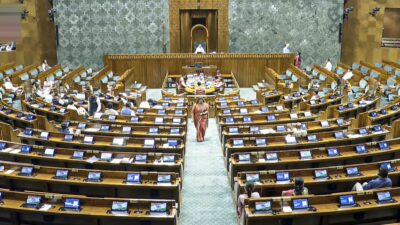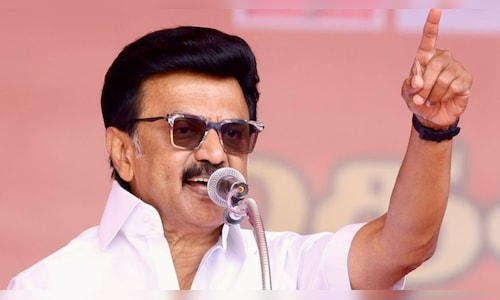
He referred to the Centre’s suggested law on delimitation as a ‘black law’. The Parliament is engaged in a special three-day session to introduce several pieces of legislation in the Lok Sabha, which include the Constitution amendment bill, a delimitation bill, and an enabling law for Union territories with legislatures — namely Delhi, Jammu and Kashmir, and Puducherry — aimed at expediting the implementation of the women’s reservation law passed in 2023.
#WATCH | Namakkal | DMK President and Tamil Nadu CM MK Stalin, dressed in black, hoists a black flag in opposition to the Centre’s delimitation initiative. He also incinerates a copy of the Delimitation bill.
(Video source: DMK) pic.twitter.com/5DioOoBYMe— ANI (@ANI) April 16, 2026
On April 15, Stalin declared a statewide black flag protest to be held on Thursday against the anticipated delimitation process, warning the Centre of repercussions and a “heavy price” if it disregarded Tamil Nadu’s concerns.
“The BJP is playing with fire.” If the Union government failed to honor Tamil Nadu’s voice and did not retreat, it would face serious consequences, Stalin stated.
He suggested that the nation might again witness “the DMK of the 1950s and 1960s,” alluding to the party’s early phase, which was characterized by numerous protests for state rights and against the perceived imposition of Hindi.
While addressing election rallies in northern Tamil Nadu, Stalin claimed on April 14 that the draft bill concerning women’s reservation represented a “conspiracy” that would widen the divide between Tamil Nadu and the northern states upon the implementation of delimitation.
Earlier this week, Telangana Chief Minister Revanth Reddy reached out to the chief ministers of southern states and the UT of Puducherry, suggesting a “hybrid model” wherein 50% of the proposed additional seats would be allocated on a pro-rata basis and the remainder based on GSDP and other criteria.