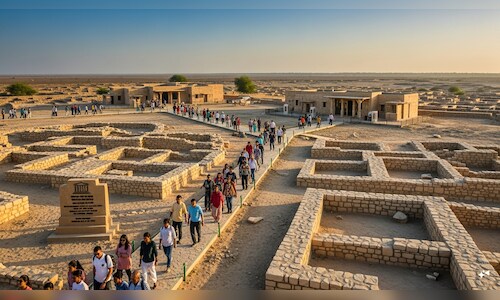
According to Bhavik Sheth, Chief Operating Officer at Evoke Experiences, the site attracts approximately 150,000 visitors annually, though numbers varied during the pandemic years.
He stated that the UNESCO recognition has greatly enhanced the site’s visibility on both national and international fronts.
“Since the recognition, there has been a continuous increase in heritage-driven tourism, academic visits, and culturally motivated domestic travel,” Sheth noted.
He further indicated that the visitor demographic has shifted from predominantly regional tourists to a more diverse group, including researchers, curated travel groups, and experiential travelers.
Policy initiatives outlined in the Union Budget 2026 are anticipated to impact the tourism trajectory of the site positively.
Finance Minister Nirmala Sitharaman has suggested developing 15 archaeological sites, including Lothal, Rakhigarhi, Sarnath, Hastinapur, and Leh Palace, as “vibrant experiential cultural destinations.”
While specific project-level allocations for individual sites are yet to be detailed, Sheth emphasized that the proposal signals a transition towards experience-focused heritage tourism.
“The vision includes opening excavated areas to the public through curated walkways, immersive storytelling, and the introduction of conservation technologies, interpretation centres, and trained guides,” he mentioned.
Tourism in Dholavira remains predominantly seasonal due to the climatic conditions of the Kutch region. Sheth remarked that most visitors come between November and February, with March and October serving as transitional months, while foot traffic drops between April and September due to elevated temperatures.
Efforts to establish the site as a year-round destination are concentrating on enhancing infrastructure and diversifying visitor experiences.
“Investments in infrastructure, such as improved access roads, shaded pathways, and upgraded onsite facilities, aim to enhance comfort beyond the winter months,” Sheth noted.
He added that initiatives like heritage interpretation programmes, school and research tourism, desert ecology experiences, and curated cultural activities are designed to expand visitation throughout the year.
The tourism linked to the site also plays a vital role in stimulating local economic activity in the surrounding Kutch region. Sheth pointed out that visitor spending supports accommodation providers, transport operators, local guides, food vendors, and handicraft sellers, while also creating indirect job opportunities through local supply chains and small businesses.
Meanwhile, the adjacent salt flats and the striking white desert landscape of the Great Rann of Kutch continue to be significant attractions for travelers.
Sheth cautioned that these ecosystems are delicate and necessitate careful management, with responsible tourism practices such as regulated access routes and controlled visitor movement essential to protect the environment while fostering tourism growth.