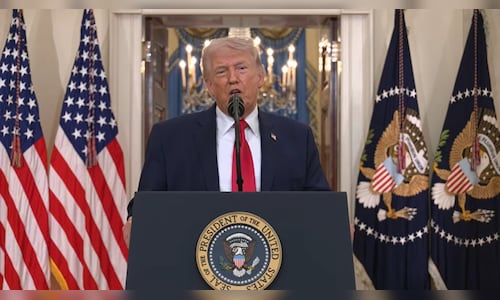
A senior official from the administration characterized the adjustments as essential for clarifying a complex policy and ensuring greater equity for businesses dealing with President Donald Trump’s tariff policies. This official spoke on the condition of anonymity to provide specifics ahead of the president’s formal announcement.
According to a White House statement, goods with total steel, aluminum, or copper content under 15% will effectively be exempt from the metals tariffs. Furthermore, certain other derivative goods will incur a reduced 25% rate if they are considered “substantially made” from one of the metals.
Products manufactured overseas but entirely from American metals will be subjected to a lower 10% tariff rate, as per the White House announcement. Additionally, certain “metal-intensive industrial equipment and electrical grid apparatus” will be taxed at a 15% rate through 2027, a strategy aimed at strengthening the US industrial sector.
Despite these developments, 50% tariffs will continue on a significant number of derivative products — such as imported steel pipe. The levy will be applied to the total value of the product, not just its metal content, according to the official.
Also Read: Trump to impose 100% tariff on certain pharmaceuticals as trade barriers escalate
Comex copper jumped as much as 1.4% immediately following the announcement before retreating to trade 0.5% lower late Thursday afternoon in the US.
This change comes after months of lobbying by companies claiming they were unfairly affected by prior duties targeting metal imports. While the administration contends that the levies are intended to promote domestic manufacturing, the extension of tariffs to so-called derivative products meant they were applied even to items with minimal metal components, which constituted only a small fraction of the overall weight and value.
The adjusted metal tariffs, established under Section 232 of the Trade Expansion Act of 1962, arrive a year after Trump initiated the core of his second-term trade strategy, imposing extensive levies on goods from numerous countries in an effort to bolster US manufacturing, enhance American access to foreign markets, and rebalance global trade dynamics.
Earlier this year, the US Supreme Court invalidated Trump’s country-specific levies since they were applied using an emergency law, yet the president has been working to reconstruct that tariff barrier through other means. On Thursday, the administration is also revealing tariffs on imported drugs, instituting higher levies on products produced by companies not manufacturing goods in the US or those that have not negotiated agreements with the White House to reduce costs for American consumers.
On Thursday, officials referenced consumer items like dental floss, which includes a small metal component for cutting the floss but lacks significant steel or aluminum content, as examples of products that would benefit from the metal tariff adjustments. Washing machines are also anticipated to receive relief.
This new structure could lead to increased duties for certain imported steel and aluminum items, albeit with the promise of simplified compliance to mitigate the impact. Previously, tariffs on steel and aluminum were levied on derivatives based on the quantity of those metals present, complicating the quick assessment of appropriate charges.
Proponents of the revised metal tariff strategy argued it would support the administration’s objectives of reshoring domestic manufacturing.
Also Read: Trump’s WH ballroom gets final approval days after judge’s ruling halting construction
“This initiative will help ensure that these tariffs work as intended to support domestic production and American labor,” stated Jon Toomey, president of the Coalition for a Prosperous America, representing US manufacturers.
The upcoming November midterm elections, which will determine control of Congress, will likely hinge on voters’ perceptions regarding the US economy. Tariffs and the conflict in Iran have increased costs for Americans, creating a potential risk for Trump’s Republican party.
The senior administration official played down the potential impact of the revised tariff structure on consumer prices.
Last year, Trump enacted a 50% levy on foreign steel and aluminum to address Chinese overcapacity. This decision adversely affected other key trading partners, including Canada, the European Union, Mexico, and South Korea. Subsequently, the administration broadened the range of products affected to include so-called derivative products that contained these metals.