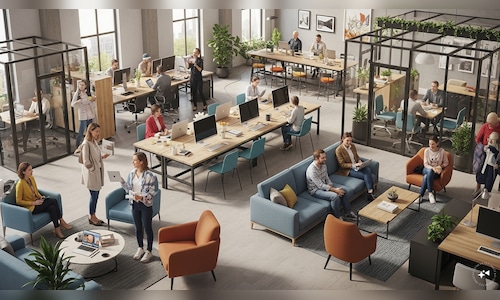
According to a recent report by Knight Frank India, the absorption of flex spaces has achieved a notable 30% compounded annual growth rate (CAGR) from 2017 to 2025, substantially surpassing the broader office market’s 9% growth during the same timeframe. This trend indicates a clear shift: flexible offices are no longer viewed as temporary solutions but as long-term, scalable options compared to traditional leasing.
The implications for this sector are extensive. As businesses focus on agility, rapid growth, and capital efficiency, flex operators are evolving from co-working providers into strategic partners that offer managed, enterprise-level workspaces. This evolution is also influencing leasing behaviors, portfolio strategies, and even the distribution of office demand across various cities.
Also read: Happiest Minds may launch its first Agentic AI for engineering soon
Enterprise demand reshapes the flex narrative
Currently, a major trend in the flexible workspace segment is the predominance of large enterprises, which represent 72% of total absorption. This marks a significant shift from the earlier co-working years dominated by startups and freelancers.
Within this sector, multinational corporations dominate, highlighting that global firms are increasingly turning to flexible formats to enter and grow in India. These companies utilize flex spaces for various purposes, such as establishing Global Capability Centres (GCCs), managing distributed teams, and executing short-cycle projects.
Shishir Baijal, Chairman and Managing Director at Knight Frank India, noted that the sector has “moved well beyond its early positioning as a startup-led phenomenon” and is now essential to enterprise real estate strategies. This change reflects a broader shift in how corporations approach office investments, prioritizing flexibility and speed over ownership and long-term commitments.
Also read: GST collections rise 8.8% to over ₹2 lakh crore in March; FY26 mop-up crosses ₹22 lakh crore
GCCs and IT sector anchor demand
A significant factor driving this transformation is the increasing importance of Global Capability Centres, which now account for 52% of flex space demand. For global corporations, flex offices offer a low-risk entry point into India, allowing for rapid scaling without substantial upfront capital outlay.
The Information Technology sector remains a key anchor of demand, with a 43% share. However, the mix of occupiers is diversifying, with BFSI firms contributing 25%, and other sectors—such as consulting, logistics, and healthcare—accounting for nearly a quarter of the demand.
This diverse mix indicates that flex spaces are being increasingly embraced across a range of industries with different operational requirements, reinforcing their significance.
Third-party IT companies are also major users, relying on flexible workspaces to manage fluctuating project-based workforces. Meanwhile, businesses focused on India are utilizing flex offices for satellite operations and short-term growth.
Penetration rises as flex becomes mainstream
The swift rise in demand has resulted in a marked increase in flex space penetration throughout India’s office market. From a mere 5% in 2017, flex spaces are projected to represent 21% of total office absorption by 2025.
In terms of absolute figures, leasing volumes have soared to 18.6 million sq ft, reflecting an 8.4-fold increase over eight years. This sustained growth signals that flex spaces have shifted from being a niche element to a central part of the office ecosystem.
Interestingly, startups now make up only 10% of total demand, with early-stage firms comprising the majority of this share. As these companies grow, many migrate to conventional office setups, indicating that flex remains most relevant during their initial growth phase rather than at maturity.
City markets reflect divergent growth patterns
India’s leading office markets are experiencing varied patterns of flex adoption, influenced by local demand drivers and industry presence. Bengaluru remains at the forefront in absolute terms, with 5.3 million sq ft of flex absorption in 2025, fueled by its robust tech ecosystem.
Pune is notable for its high penetration levels, with flex spaces accounting for 31% of total office absorption, signaling strong adoption among occupiers. The Mumbai Metropolitan Region has also emerged as a prominent flex market, achieving its highest recorded volumes and notable penetration.
In the National Capital Region, flex demand has surged in recent years, with 2024 marking a pivotal point before stabilizing on a higher baseline. Chennai and Kolkata illustrate how even smaller or traditionally slower markets are gaining momentum, with Kolkata achieving the highest penetration at 34%.
A structural shift, not a cyclical trend
The growth of flexible workspaces reflects a profound, structural change in India’s office market rather than a mere cyclical rise. As enterprises progressively adopt hybrid work models and distributed operations, the demand for flexible, scalable office solutions is likely to remain robust.
For developers and operators, this necessitates a transition to a more service-oriented approach, where workspace design, technology integration, and customization become crucial differentiators. For occupiers, it signifies a shift towards more dynamic and cost-effective real estate strategies.
In this context, the flex revolution is not only altering where India works but is fundamentally redefining how companies conceptualize workspaces.