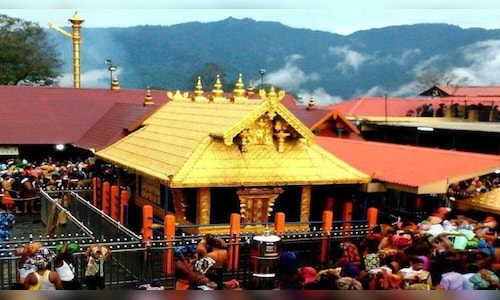
From the alleged gold heist to the debate over women’s access to the hill shrine, the issue has transformed into a complex clash between faith-driven mobilization and secular political positioning.
The temple debate is shaping electoral narratives in constituencies such as Kazhakootam, where the alleged Sabarimala gold theft case adds a sensitive layer to an already competitive triangular contest among CPI(M), Congress, and BJP candidates.
The political relevance of Sabarimala extends beyond religious sentiment, intersecting with identity politics, governance credibility, and ideological positioning within Kerala’s polarized political landscape.
FROM COURTROOM TO CAMPAIGN TRAIL
The Sabarimala debate gained national attention following the Supreme Court’s 2018 verdict that permitted women of all ages to enter the temple, declaring the traditional ban unconstitutional and a violation of equality and religious freedom rights.
Also Read: Assam Assembly Elections 2026: PM Modi accuses Congress of planning law to protect infiltrators
This ruling sparked widespread protests, hartals, and political mobilization across Kerala, evolving what started as a constitutional issue into a deeply emotional political matter.
Over time, political parties have repeatedly revisited their positions, reflecting a delicate balance between progressive commitments and electoral realities.
Experts note that the issue has become a touchstone for discussions on secularism, gender rights, and the limits of state intervention in religious practices.
Recent developments indicate that the debate is far from settled.
The Supreme Court’s ongoing review of the judgment and evolving political rhetoric keep the issue alive in the public sphere.
GOLD ROW ADDS NEW POLITICAL FLASHPOINT
The alleged Sabarimala gold theft has introduced a new layer to the debate, intensifying political attacks as the election approaches.
This controversy features prominently in campaign discussions, particularly in Kazhakootam, where CPI(M) leader and former Devaswom Minister Kadakampally Surendran faces criticism regarding alleged irregularities tied to temple administration.
Also Read: Iran US Israel War Live Updates
The Kerala High Court had previously ordered an investigation into discrepancies concerning gold plating in temple structures, amplifying political scrutiny around the governance of religious institutions.
Opposition leaders have raised concerns about the investigation’s pace, alleging delays in filing a preliminary chargesheet and worrying that the case may not reach a conclusion.
This issue allows rival parties to frame the debate around accountability and transparency, connecting temple administration to broader governance issues.
SHIFTING POLITICAL POSITIONS AHEAD OF POLLS
The Kerala government’s changing stance on women’s access to Sabarimala has sparked heated exchanges between the ruling CPI(M) and Opposition parties.
Leader of the Opposition VD Satheesan accuses the government of altering its position for electoral gain, asserting that the Left is aligning more closely with the Opposition’s previous stance.
In response, CPI(M) leaders defend the shift as a reflection of prevailing public sentiment and social consensus, highlighting that decisions regarding religious customs require consultations with scholars and reformers.
Also Read: Modi govt proposing to up Lok Sabha size by 50%; move will disadvantage southern states: Congress
Recent reports suggest that the ruling Left Democratic Front is now focusing on preserving temple traditions, indicating a recalibration of its earlier position that supported unrestricted entry.
Political observers point out that this shift illustrates how parties across the spectrum are striving to balance constitutional principles with faith-based voter sentiments.
RELIGION, IDENTITY AND ELECTORAL CALCULUS
The Sabarimala issue continues to shape political alignments in Kerala, influencing campaign narratives, coalition strategies, and voter mobilization patterns.
Community organizations such as NSS and SNDP emphasize the importance of maintaining temple traditions, reflecting the ongoing significance of the issue among certain voter segments.
Experts argue that this controversy highlights a broader challenge for political parties in reconciling secular governance frameworks with religious traditions in a diverse electorate.
In constituencies with triangular contests, such as Kazhakootam, the temple debate can impact vote margins, particularly when combined with local factors and candidate-specific issues.
LONG SHADOW OVER 2026 POLL
As Kerala approaches the 2026 Assembly elections, Sabarimala transcends mere religious significance. It has evolved into a political lens through which questions of identity, governance, and ideological positioning are refracted.
Also Read: Congress leader Chennithala alleges Rs 700 cr software scam in Kerala cooperative sector, targets LDF
Whether framed through the lens of constitutional morality, faith, or electoral pragmatism, the temple debate continues to cast a long shadow over the state’s political landscape, shaping narratives that go well beyond a single shrine.
With parties reevaluating strategies and voters navigating competing claims of tradition and progress, the Sabarimala question highlights the enduring intersection of religion and politics in Kerala’s electoral arena.