“We’re still in the early stages, but it’s evident that AI will significantly influence the progress of science,” stated OpenAI in a blog post.
What is Prism?
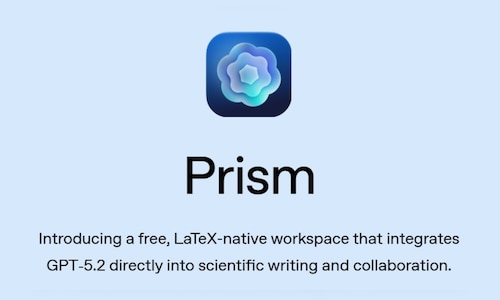
Prism is an AI-enhanced workspace tailored for scientists and researchers to write, revise, and work together on research papers. What sets Prism apart is its integration of GPT 5.2, OpenAI’s most sophisticated AI for mathematical and scientific analysis.
It empowers scientists to create documents, manage notes, examine data, and collaborate with peers, all within a single platform.
How does it work?
Typically, research tasks are spread across numerous tools, forcing a researcher to switch between Word documents, Google Docs for writing, PDFs for reviewing papers, LaTeX tools for mathematical equations, citation managers for references, and various AI chat tools for assistance.
Rather than treating AI as a separate entity, Prism allows researchers to utilize AI directly within their documents. It seeks to unify all research activities in one cohesive environment.
What does Prism allow researchers to do?
With Prism, researchers can achieve nearly all aspects of writing a scientific paper in one location, supported by AI at every step. They can engage in discussions with GPT 5.2 Thinking right within their project to brainstorm new concepts and validate hypotheses.
Additionally, researchers can draft and modify papers while AI accesses the entire document, including surrounding text, equations, figures, and the overall framework. They can also search for relevant studies, like those on arXiv, without leaving the platform.
Prism enables users to transform whiteboard equations or diagrams straight into LaTeX, make immediate edits within the document, and use optional voice commands for swift adjustments without disrupting their workflow.
What’s next?
Prism will soon be accessible to organizations using ChatGPT Business, Enterprise, and Education plans.
(Edited by : Sudarsanan Mani)
First Published: Jan 28, 2026 10:57 AM IST