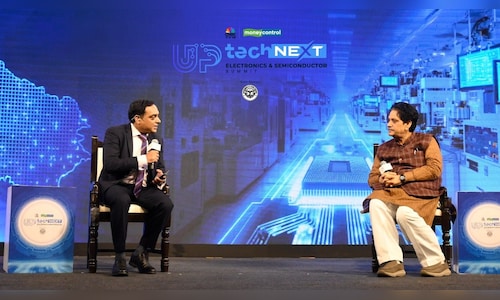
To kick things off, Sunil Kumar Sharma, Minister for Information Technology & Electronics, Uttar Pradesh, discussed the foundational steps already underway. The state has designated substantial land areas for forthcoming semiconductor facilities, bolstered by central government funding through the National Semiconductor Mission. With the first facility expected to commence operations by 2027–28, he emphasized that UP’s goal is not symbolic involvement but substantial capacity-building. The development of a robust investor ecosystem, combined with state incentives, showcases this commitment. For him, reducing foreign dependency and generating skilled jobs are central to this policy transformation.
With a focus on economic strategy, Awanish Kumar Awasthy, Chief Advisor of Chief Minister Yogi Adityanath, asserted that semiconductor manufacturing is now pivotal to UP’s aspiration of achieving a $1 trillion economy. As domestic chip usage escalates, he contended that self-reliance has transitioned from being merely aspirational to an economic imperative. He also noted the rising revenues as early indicators of policy impact, while advocating for enhanced inter-departmental coordination and increased public–private partnerships to expedite real-world implementation.
Representing a national perspective, Dr. Sushil Pal, IAS, Joint Secretary, MeitY, elaborated on how Semicon 2.0 signifies India’s evolution from policy design to actual policy implementation. Over the next 3–4 years, the focus will be on strengthening fabs, advancing node capabilities, and establishing a comprehensive semiconductor value chain rather than isolated facilities.
Crucially, UP’s semiconductor vision transcends the industry. Dinesh Pratap Singh, MoS (Independent Charge), Horticulture, Agricultural Marketing, Agricultural Foreign Trade & Agricultural Exports, Uttar Pradesh, illustrated how chip-enabled agri-tech can revolutionize farming efficiency and traceability. Meanwhile, JPS Rathore, MoS (Independent Charge), Cooperative, Uttar Pradesh, emphasized prospects for cooperatives and public services through digital and semiconductor-driven innovations.
Concluding the day’s discussions, a multi-stakeholder panel conveyed a unified conviction: with a skilled workforce, export-oriented policies, and flourishing manufacturing hubs, Uttar Pradesh is progressively establishing itself as a significant semiconductor center in India’s forthcoming growth narrative.
Explore the full dialogue between policymakers, industry leaders, and innovators from the summit here