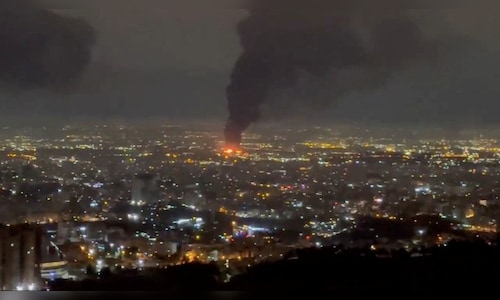
The status of another third remains ambiguous, but bombings likely caused damage, destruction, or entombed those missiles in underground facilities, four of the sources indicated, speaking on condition of anonymity due to the sensitive nature of the information.
One source noted that the assessment applied similarly to Iran’s drone capabilities, suggesting a reasonable degree of certainty that a third have been destroyed.
This assessment, which has not been previously disclosed, reveals that while most of Iran’s missiles are either destroyed or inaccessible, Tehran still maintains a substantial missile inventory and could potentially recover some buried or damaged missiles once hostilities cease.
This intelligence stands in contrast to President Donald Trump’s public statement on Thursday that Iran has “very few rockets left.” He also seemed to acknowledge the threat posed by the remaining Iranian missiles and drones to any future US operations aimed at protecting the economically critical Strait of Hormuz.
Reuters first reported that he is considering whether to escalate the conflict by deploying US troops to Iranian shores along the Strait.
”The problem with the straits is this: let’s say we do a great job. We say we got 99% (of their missiles). 1% is unacceptable because 1% is a missile going into the hull of a ship that cost a billion dollars,” Trump remarked during a televised Cabinet meeting on Thursday.
In response to inquiries, a Pentagon official mentioned that Iranian missile and drone strikes had decreased by about 90% since the onset of the war. The US military’s Central Command also reported having damaged or destroyed over 66% of Iranian missile, drone, and naval production facilities and shipyards.
The White House did not immediately comment on the matter.
Democratic Rep. Seth Moulton, a Marine Corps veteran with four tours in Iraq, refrained from commenting on Reuters’ findings but disputed Trump’s claims regarding the war’s impact on Iran’s arsenal.
”If Iran is smart they’ve retained some of their capability – they’re not using everything that they have. And they’re laying in wait,” Moulton stated.
IRAN’S MISSILES ARE PRIME US TARGET
The Trump administration has stated its goal is to weaken Iran’s military by targeting its navy, destroying its missile and drone capabilities, and ensuring that the Islamic Republic never acquires nuclear weapons.
Central Command has remarked that its operation, officially referred to as “Epic Fury,” is proceeding on schedule or even ahead of the plans set out prior to the February 28 initiation of US and Israeli assaults on Iran.
As of Wednesday, US strikes have targeted over 10,000 Iranian military sites, and according to Central Command, have sunk 92% of the Iranian navy’s large vessels. The US military has released images showing attacks on factories responsible for producing Iran’s armaments and has emphasized that it is focused not only on missile and drone stockpiles but also on the infrastructure that generates them.
Nevertheless, Central Command has refrained from specifying the exact extent of destruction to Iran’s missile or drone capabilities.
One source noted that a part of the challenge lies in assessing how many Iranian missiles were stockpiled in underground facilities prior to the commencement of the war. The US has not disclosed any estimates of Iran’s pre-war missile inventory.
Israeli military officials suggest that Iran had 2,500 ballistic missiles capable of reaching Israel before the conflict began. More than 335 missile launchers have been “neutralized,” representing 70% of Iran’s launch capacity, according to a senior Israeli military official.
Israeli authorities have not publicly revealed their estimates of how many missiles Iran still possesses, but privately acknowledge that eliminating the remaining estimated 30% of Iran’s capability could be relatively more challenging.
IRAN STILL FIRING AT NEIGHBORS
Despite the rapid pace of US strikes, Iran has demonstrated that its weaponry stockpile is far from depleted.
On Thursday alone, it reportedly fired 15 ballistic missiles at the United Arab Emirates, along with 11 drones, as stated by the UAE’s Defense Ministry.
It has also showcased new capabilities. Just last week, Iranian forces launched long-range missiles for the first time, targeting the US-UK military base at Diego Garcia in the Indian Ocean.
Nicole Grajewski, an expert on Iran’s missile forces and the Islamic Revolutionary Guard Corps at Sciences Po in Paris, conveyed concern that the Trump administration may have exaggerated how significantly US strikes have compromised Iranian capabilities.
She pointed to Iran’s continued ability to execute operations from the Bid Kaneh military facility, which has endured heavy bombardment.
”The fact that they’ve managed to sustain this, I think, indicates the US was overstating the success of its operation,” Grajewski remarked, adding that she believes Iran still retains approximately 30% of its missile capabilities.
Grajewski mentioned that Iran possesses over a dozen large underground facilities capable of housing launchers and missiles, raising the question: “Have these facilities collapsed?”
IRAN’S TUNNELING
One senior US official expressed doubt regarding the United States’ capacity to accurately ascertain Iran’s missile capabilities, primarily because it remains unclear how many are situated underground and accessible. “I don’t know if we’ll ever have an accurate number,” the official stated.
Defense Secretary Pete Hegseth acknowledged the challenges presented by Iran’s tunneling on March 19, noting: “Iran is a vast country. And just like Hamas and their tunnels (in Gaza), they’ve funneled any aid—economic or humanitarian—into tunnels and rockets.”
“But we are hunting them down methodically, ruthlessly, and overwhelmingly, like no other military in the world can do, and the results speak for themselves,” he said, though he did not provide specifics on the percentage of missiles or drones that have been destroyed.