
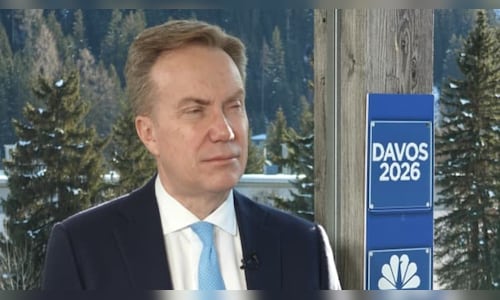
US President Donald Trump’s warning about imposing tariffs on Europe if it does not hand over Greenland has raised alarms, with World Economic Forum (WEF) President and CEO Borge Brende anticipating heated discussions between the nations at Davos this week.
“I believe we will see some tough and candid discussions here, often referred to as frank dialogues in diplomatic terms, centered around these issues, particularly tariffs,” Brende shared with CNBC-TV18, pointing out that the tariff conflict has lingered for nearly a year among the US and various stakeholders.
With approximately 850 of the globe’s leading CEOs gathering in Davos this year, he noted that Trump is eager to participate in the forum to engage directly with global business leaders.
These remarks follow Trump’s announcement on Saturday of extensive tariffs targeting eight European countries — Denmark, Norway, Sweden, France, Germany, the Netherlands, Finland, and Great Britain — all of which agreed to deploy personnel for a NATO exercise in Greenland. Trump has connected this action to increasing geopolitical tensions surrounding Greenland while rekindling his long-standing interest in acquiring the territory from Denmark.
Brende mentioned that Europe recognizes its strategic position amid major powers and aims to keep communication lines open with both the US and China. “Europe is acutely aware of the need to avoid being caught between a rock and a hard place,” he stated, emphasizing that the region will maintain its dialogue with the US, as it continues to be a crucial export market.
He also highlighted Europe’s initiatives to enhance collaboration with China, mentioning that German Chancellor Frederick Merz will visit China immediately after Davos to meet with Xi Jinping. He suggested this illustrates a “new context” in global business operations, signaling the emergence of different business dynamics.
It is important to note that Trump has recently initiated a special operation to capture Venezuelan President Nicolás Maduro, asserted that Ukraine is less inclined to seek peace than Russia, and threatened military action against Iran if dissent is suppressed.
Also Read: Davos 2026: Geoeconomic tensions top business risk for 2026, says WEF’s Saadia Zahidi
Regarding economic growth amid global uncertainty, Brende expressed that he had been concerned last year about potential geopolitical upheaval significantly impacting global growth. “However, the economy has shown remarkable resilience, and we still foresee over 3% economic growth this year,” he indicated.
Nevertheless, he cautioned that any escalation of conflicts could thwart prosperity, stating that emerging technologies like artificial intelligence (AI) have become vital growth drivers.
He noted that approximately $1.5 trillion was invested in AI and frontier technologies last year alone.
Commenting on unprecedented sovereign debt levels globally, Brende remarked, “We haven’t experienced such levels of government debt on a global scale since 1945,” highlighting the heavy interest payments many countries now face. He emphasized that the only sustainable path to alleviate the debt cycle is through higher global growth, adding that defense spending — while regrettable due to worldwide mistrust — has historically driven technological progress.
Concerns over AI bubble and bilateral trade agreements
Discussing technology markets and fears of an AI bubble, Brende indicated that while a bubble is unlikely, it remains a possibility, given the significant US investment in this sector amid uncertain returns. He believes that even with market corrections, the foundational technologies will continue to bring transformative change.
“Regardless of market corrections, I am confident that artificial intelligence and frontier technologies will define this century,” he stated, drawing parallels with past bubbles in railways, electricity, and the dot-com era.
On trade relations, Brende observed that the multilateral trading system has evolved, with countries increasingly favoring bilateral and plurilateral agreements. “The multilateral trade framework has shifted… nations are now swiftly pursuing bilateral agreements,” he noted. He added that while trade in manufactured goods has slowed, the sectors of digital trade and services continue to grow.
Brende was optimistic about India’s growth trajectory. “The economic reforms implemented in India over the past months have been quite impressive,” he remarked, suggesting that India could account for up to 20% of global growth this year. He noted that India is among the fastest-growing major economies and expressed hope for advancing a trade agreement between New Delhi and Washington this year.


