The duo, seen as possible successors to Trump, are now involved in ongoing negotiations aimed at resolving the war as the Republican Party contemplates its future post-Trump.
Vance has adopted a cautious stance, reflecting his doubts about extended U.S. military involvement, whereas Rubio has closely aligned himself with Trump’s aggressive approach and has become a prominent defender of the administration’s actions.
Trump indicated that both individuals are part of efforts to compel Iran to comply with U.S. demands regarding its nuclear and ballistic missile programs, as well as the free flow of oil through the Strait of Hormuz.
With the next presidential election slated for 2028 and Trump’s term limits preventing a re-election, the president has privately posed the succession question to his allies and advisers, asking “JD or Marco?,” according to two sources familiar with his sentiments.
The outcome of the U.S. military operation, now in its fifth week, could influence the 2028 ambitions of both men, analysts and Republican insiders say. A quick resolution to the conflict that is favorable to the U.S. might benefit Rubio, who also serves as Trump’s national security adviser, potentially positioning him as a reliable figure during a crisis. Conversely, a protracted conflict could allow Vance to present himself as echoing the anti-war sentiments of Trump’s base without overtly separating from the president.
Trump’s own reputation is also on the line, with his approval rating recently dropping to 36%, the lowest since his return to the White House, according to a recent four-day Reuters/Ipsos poll.
Some Republicans are closely monitoring which senior aide Trump appears to prefer as the situation in Iran develops. There are indications that Trump seems to favor Rubio, although this could shift quickly.
“Everyone is paying attention to Trump’s body language towards Rubio, which is not the case with Vance,” remarked a Republican with ties to the White House.
The White House has dismissed suggestions that Trump is signaling a preference.
“No amount of wild media speculation about Vice President Vance and Secretary Rubio will distract this administration from its mission of fighting for the American people,” stated spokesman Steven Cheung.
FROM TRUMP RIVALS TO LIKELY HEIRS
Vance, 41, a former Marine with service in Iraq, has consistently opposed U.S. involvement in foreign conflicts. His public comments on Iran have been measured and limited, with Trump acknowledging their “philosophical differences” regarding the situation.
Once a declared “never-Trumper,” Vance penned an opinion piece in the Wall Street Journal in 2023 arguing that Trump’s most effective foreign policy was avoiding wars during his first term from 2017 to 2021.
The White House has played down any perceived rift between the president and the vice president. Standing alongside Trump in the Oval Office earlier this month, Vance expressed his support for Trump’s management of the war, agreeing that Iran should be prevented from acquiring a nuclear weapon.
Should Trump’s special envoy Steve Witkoff and son-in-law Jared Kushner make substantial progress in negotiations, Vance may take on a more active role, a knowledgeable source said.
“Vice President Vance is proud to be part of a highly effective team under President Trump’s bold leadership, which has achieved remarkable success in enhancing America’s safety, security, and prosperity,” said a spokeswoman for Vance.
A senior White House official, who requested anonymity to discuss a sensitive topic, indicated that Trump is accepting of ideological differences as long as aides demonstrate loyalty, adding that Vance’s skeptical perspectives inform Trump about segments of his voter base.
A source familiar with Vance’s viewpoint informed Reuters that the vice president intends to wait until after the November midterm elections to decide on a 2028 run.
Vance won the straw poll at the Conservative Political Action Conference, with approximately 53% of over 1,600 attendees voting for him as the next Republican nominee. The results released on Saturday also showed Rubio gaining traction, finishing second with 35%, a significant increase from just 3% the previous year.
Rubio, 54, has stated he would not run for president if Vance does, and sources indicate he would be satisfied as Vance’s running mate.
However, any hint of vulnerability for Vance might embolden Rubio and other Republicans considering bids.
“Trump has a long memory,” noted Republican strategist Ron Bonjean. “He may criticize Vance for perceived disloyalty. If Trump retains popularity with the MAGA base, this could affect Vance’s chances of securing the president’s endorsement.”
Trump has floated the idea of a joint ticket featuring Vance and Rubio, suggesting they would be a formidable combination.
“Trump doesn’t want to choose anyone outright,” the senior White House official remarked.
A March Reuters/Ipsos poll indicated that 79% of Republicans hold a favorable view of Vance, while 19% view him unfavorably. In contrast, 71% have a positive view of Rubio, with 15% viewing him negatively.
For comparison, 79% of Republicans view Trump favorably, while 20% hold an unfavorable opinion.
Rubio, whose presidential ambitions in 2016 were derailed after a contentious clash with Trump, has effectively resolved any lingering frictions with the president.
State Department spokesman Tommy Pigott emphasized that Rubio “has a strong professional and personal relationship” with Trump’s team.
Both Rubio and the White House had to engage in damage control after he upset some of Trump’s conservative supporters by suggesting that Israel influenced the U.S. into the war. However, in recent weeks, Trump has acknowledged Rubio’s contributions favorably.
When asked if Rubio was concerned that a drawn-out war could hinder his political prospects, a senior State Department official noted, “He hasn’t spent any time worrying about that.”
DIFFERENCES ON DISPLAY
Matt Schlapp, a conservative figure who heads CPAC, believes the Iran conflict will have significant political ramifications.
“If it’s perceived as successful in accomplishing its goals…I believe individuals will be politically rewarded for making the right choices,” Schlapp stated. “If it drags on indefinitely… I think the political landscape will be challenging.”
Republicans remain largely in favor of U.S. military strikes against Iran, with 75% approving, compared to only 6% of Democrats and 24% of independents, according to Reuters/Ipsos polling.
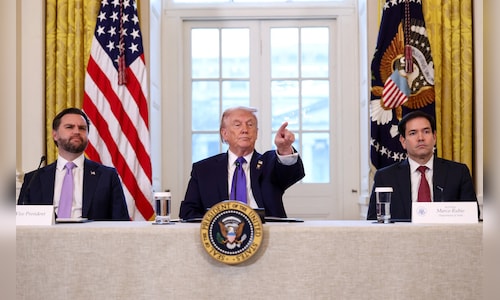
During a televised Cabinet meeting on Thursday, the differences between Rubio and Vance were evident.
Rubio delivered a strong defense of Trump’s actions against Iran. “He’s not going to let such a threat remain,” declared the Secretary of State.
Vance took a more restrained approach, emphasizing the need to prevent Iran from obtaining nuclear capabilities. He concluded by sending well wishes to Christians and U.S. troops in the Gulf for the Holy Week and Easter.
“We continue to support you,” he expressed to servicemembers, “and we will stand by you every step of the way.”