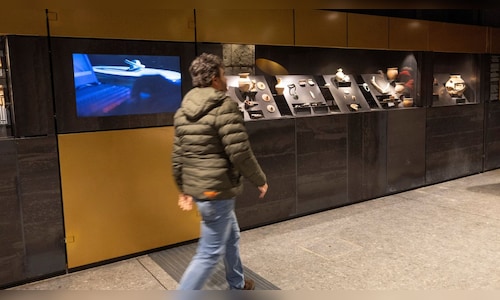
Spanning four levels and reaching a depth of 32 meters in the heart of Rome, the newly opened “Colosseo-Fori Imperiali” station on the city’s C-line represents a remarkable achievement in modern engineering.
For the cost of a 1.5-euro ticket, visitors can explore the station’s underground museum, which houses 350 items ranging from ceramic jugs and lamps to bronze statuettes and a wooden sword.
Nearby, the remains of a bathhouse from the residence of an affluent Roman are on display.
Also read | Instagram-worthy travel destinations: 10 places around the world that guarantee picture-perfect memories
Ancient Rome was constructed in layers; temples and forums were erected on older foundations, which were then covered, resulting in a captivating landscape for archaeologists.
At street level, a triangular opening provides a unique perspective of the Colosseum.
“The most significant achievement we’ve accomplished is providing insight… into daily life,” stated Elisa Cella, an archaeologist at the Colosseum archaeological park, during the presentation.
Extraordinary past
Rome’s mayor, Roberto Gualtieri, described the station’s inauguration as “an extraordinary and historic event.”
He also defended the expensive and protracted works that have caused considerable disruption for residents and tourists in the vicinity over the years.
The project faced multiple delays due to public complaints and unforeseen discoveries.
Also read | US travel ban: Trump adds more countries to entry restrictions; check full list here
“These archaeological excavations and findings are not an impediment,” he remarked, highlighting them as opportunities to uncover the city’s “extraordinary past.”
Confronted with Rome’s unique geological challenges, the excavation team utilized a technique called “descending archaeology,” specifically tailored for underground stations in historic areas.
This approach involves installing intermediate slabs as the excavation moves downward, ensuring the structural integrity of the site.
The Porta Metronia station was also inaugurated on Tuesday, where excavations revealed an extensive military complex from the 2nd century AD, including a residence adorned with frescoes and mosaics.
The residence has been dismantled, restored, and reassembled in a space from which metro passengers can view it via an elevated walkway.
“Rome has always built on top of itself,” noted Simona Morretta, leader of excavations and the Porta Metronia museum.
Initiated in 2007, the construction of the C line linking the city’s northeast to the southeast has encountered significant delays.
Once completed, it will feature 31 stations over a span of 29 kilometers.
(Edited by : Jerome Anthony)