
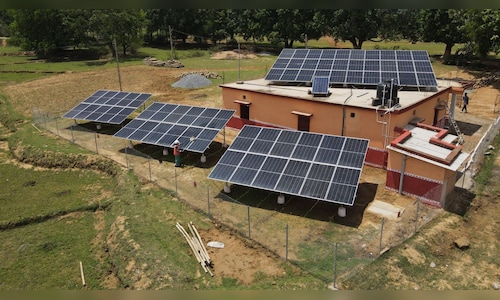
The Chief Project Manager of the grid corporation, Mahesh Das, informed ANI that the state encounters significant challenges in securing suitable land for traditional ground-mounted solar installations, with most available land being either agriculturally viable or environmentally protected.
“Odisha suffers from a land scarcity… As you know, we have fertile lands mainly reserved for agricultural use. Approximately 18 to 30% of land is either forested or designated for other purposes. Thus, we lack extensive tracts of land for developing ground-mounted solar power facilities,” he stated on December 13.
Also read | Infrastructure expansion provided a ‘significant boost’ to spiritual tourism in the country: Shekhawat
To tackle this challenge, the state intends to place solar panels on floating platforms over reservoirs and other water bodies. Das explained that this method not only mitigates land issues but also enhances operational efficiency.
He pointed out that Odisha is rich in freshwater resources, making it ideal for large-scale floating solar initiatives.
“We are fortunate to have numerous water bodies. There are 185 water bodies, consisting of medium, minor, and major reservoirs available. We now aim to develop these water bodies into floating solar surfaces. The idea of floating solar surfaces has been established and is a proven technology,” Das elaborated.
The water bodies will utilize floaters for mounting solar panels, with power being harvested from this setup. This generation will feature high efficiency due to its closeness to water, thus minimizing the need for cleaning.”
As per Das, the natural cooling effect of water enhances solar panel efficiency while also decreasing upkeep necessities, such as frequent cleaning.
GRIDCO has already initiated steps toward this transition. A tender for a floating solar project of approximately 1,000 megawatts has been released for the Rengali reservoir. Additional developments are anticipated at Upper Indravati and Hirakud reservoirs.
“The second aspect is that efficiency increases owing to the cooling effect on the panels. We have already issued a tender for the Rengali reservoir, around 1000 megawatts, for captive purposes. The following phase will involve 225 megawatts in Upper Indravati and 1.5 gigawatts in Hirakud. We will address all these water bodies collectively and comprehensively,” Das added.
Highlighting the environmental significance of this initiative, Das underscored the urgency of expanding green energy capacity to lower carbon emissions, particularly in a heavily industrialized state like Odisha.
“We need to reduce carbon dioxide emissions, which is impossible without fostering our ecosystem for green energy. Odisha is responsible for producing at least 30% of the nation’s steel, but we are simultaneously generating carbon dioxide,” he remarked.
(Edited by : Jerome Anthony)


