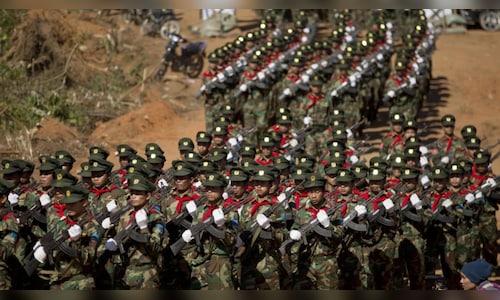
The Union Solidarity and Development Party has attained 193 out of 209 seats in the lower house and 52 out of 78 seats in the upper house following two rounds held on December 28 and January 11. Voter turnout hovered around 55% in both rounds, significantly lower than the approximately 70% seen in the 2020 and 2015 elections.
Major opposition factions are abstaining from the polls due to a civil conflict ignited by the 2021 coup that reinstated military control. The United Nations, various rights organizations, and the UK have condemned the elections as a farcical effort to extend the military’s grip.
Malaysia, which presided over the 11-member Association of Southeast Asian Nations last year, has stated that the bloc will not endorse the election.
”Regardless of whether the international community recognizes this, we fail to understand their viewpoint. The people’s vote is the acknowledgment we seek,” junta chief Min Aung Hlaing expressed to reporters on Sunday, as shown in a state TV broadcast.
The military maintains that the election is free of coercion and enjoys public support.
YANGON AND MANDALAY VOTE
On Sunday, voters were submitting their ballots in around 60 townships, including major cities such as Yangon and Mandalay. Clad in civilian attire, Min Aung Hlaing previously engaged with voters at a polling station in Mandalay, as depicted in images from local media.
The 69-year-old general and acting president has suggested he may appoint a successor as armed forces chief, potentially transitioning into a fully political role, according to a source.
When asked on Sunday about his potential future role in government, Min Aung Hlaing said it was premature to comment. ”Once the Parliament is convened, they will follow their own procedures and methods for selection,” he noted.
Despite the junta portraying the election as a success despite low turnout, residents in Myanmar’s largest cities described a climate of fear, with many feeling pressured to vote to avoid possible arrest or retaliation.
A Yangon inhabitant mentioned that polling stations in areas where military officers and their families reside exhibited a higher turnout on Sunday, whereas few voters were visible in other regions.
The military seized control of the impoverished Southeast Asian nation in a morning coup on February 1, 2021, ousting an elected civilian government led by Nobel Peace Prize laureate Aung San Suu Kyi.
The 80-year-old leader remains detained, and her National League for Democracy, among other opposition factions, has been disbanded by the junta.
Conflict has persisted throughout the election campaign and prior voting in numerous regions of Myanmar, including airstrikes near civilian areas in border states like Rakhine, Shan, and Kayin.
MILITARY SET TO HOLD POWER
The USDP, established in 2010 and which governed the country for five years after the end of a prior military rule, is led by a retired brigadier general and filled with other former high-ranking officers.
Myanmar’s military, which has dominated the country for five of the last six decades, appears to have no genuine intention of relinquishing its political leadership.
”Instead of resolving a crisis now entering its fifth year, the election is more likely to bolster the military’s grip on power, with little chance of restoring domestic legitimacy or enhancing the country’s standing with Western allies,” remarked Kaho Yu, Principal Asia Analyst at risk intelligence firm Verisk Maplecroft.
Employing an election protection law, the junta has charged over 400 individuals for criticizing and obstructing the election process, according to state media.