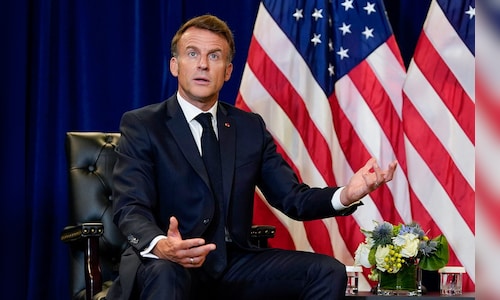
“Europe is capable of earning respect, and that is commendable,” Macron remarked to reporters upon his arrival in Brussels for an emergency summit. “When we utilize the tools at our disposal, we gain respect, and that is what transpired this week.”
Ahead of the EU meeting, Trump significantly retreated from his previous call to “acquire” Greenland, a semiautonomous part of Denmark. For the first time, he indicated that he would not resort to force to take the island. Trump also withdrew his threat to impose tariffs on European countries that backed Denmark.
The EU’s strategies included a non-aggressive deployment of several dozen troops to Greenland for reconnaissance, aimed at preparing for future exercises and signaling to Trump that Europe is addressing security—the primary reason the US president cited for his interest in the mineral-rich territory.
The EU additionally pledged to counter Trump’s tariff threats with its own measures while engaging with members of the US Congress and the business sector concerned about his ambitions for Greenland.
Read more: Trump retracts invitation to Canada’s PM Carney for Gaza Board of Peace
However, there are no guarantees that the unpredictable US leader won’t shift his stance again.
Trump’s aggressive demeanor necessitates a reassessment
Prior to backing down, Trump had urged Denmark and NATO to allow him to have Greenland, issuing a foreboding warning: “You can say yes, and we will be grateful. Or you can say no, and we will remember.”
Polish Prime Minister Donald Tusk emphasized that “the United States remains our most crucial partner regarding security.” Nevertheless, Tusk pointed out the need “to distinguish between domination and leadership. Leadership is acceptable.”
No details have emerged about the hastily arranged “framework” deal that led to Trump’s unexpected retreat, leaving room for skepticism. Danish Prime Minister Mette Frederiksen argues that her country will not negotiate its sovereignty.
“We are a sovereign state and cannot negotiate on that issue, as it pertains to fundamental democratic values. However, we can talk about enhancing our collaborative security efforts in the Arctic region,” she informed reporters in Brussels.
Doubts surrounding the Board of Peace
European leaders are also anticipated to agree on a unified stance regarding Trump’s proposed “Board of Peace,” which was initially intended to be a small group of international leaders supervising the Gaza ceasefire but has evolved into a much broader initiative.
On Thursday, just days after informing the Norwegian prime minister via text that he no longer felt “obligated to prioritize Peace,” Trump highlighted the proposed board at Davos.
Trump has suggested that the board could take over certain roles currently held by the United Nations.
Several European nations have declined invitations to participate. Norway, Slovenia, and Sweden have stated their unwillingness to join. When informed that Macron was unlikely to accept the invitation, Trump replied: “I’ll impose a 200% tariff on his wines and champagnes, and then he’ll join.” Germany has provided a cautious and noncommittal reaction to Trump’s request, while Hungary and Bulgaria have agreed to participate.
A challenging landscape
Before the summit, European Council President António Costa, who is leading the meeting, stated that the Trump administration poses challenges to Europe’s security, principles, and prosperity.
“All of these three dimensions are currently being tested in transatlantic relations,” Costa noted.
Read more: Donald Trump’s Board of Peace: Morocco, UAE join; France, UK decline; Canada withdraws
After consulting with the leaders, Costa affirmed their unity on “the principles of international law, territorial integrity, and national sovereignty,” which the EU underscores while supporting Ukraine against Russia and which Trump has threatened in Greenland.
In a speech to EU lawmakers in Strasbourg, France, he insisted that “additional tariffs would harm transatlantic relations and contradict the EU-US trade agreement.” EU lawmakers must ratify that agreement, but on Wednesday they postponed their vote due to Trump’s threats.
The EU leaders have been energized by Trump’s aggressive stance over Greenland and are reevaluating their relationship with a capricious America, their long-standing ally and the most powerful member of NATO.