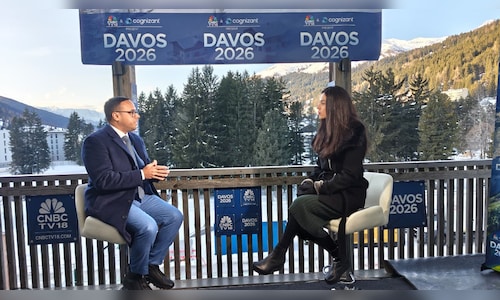
In an interview with CNBC-TV18 during the World Economic Forum 2026 in Davos, Sachdeva noted that Indian IT firms have largely adapted to AI adoption and are strategically positioned to harness increasing enterprise demand.
AI has been a focal point of discussions in Davos this year, with global firms aiming to transition from pilot projects to widespread implementation. Sachdeva pointed out that this transition is already being observed across various sectors and will directly bolster IT services growth. “Watch for a surge in Indian IT services growth rates this year,” he remarked, highlighting that companies that were initially hesitant now have robust strategies in place.
He emphasized that the demand from large enterprises for AI agents and smaller language models, deployed securely and effectively, remains exceptionally strong. Enterprises have shifted from experimentation to integrating AI into their essential operations, generating ongoing work for IT service providers. “The critical shift is that companies have moved beyond a proof-of-concept mentality to a production-focused approach,” Sachdeva explained.
Sachdeva referred to Uniphore’s own expansion as a testament to this broader movement. The company raised $260 million in a Series F funding round in 2025, with notable investors including Nvidia, AMD, Snowflake, and Databricks. He indicated that this round was more about validating Uniphore’s status in enterprise AI than simply raising capital. Over the past year, the company experienced growth exceeding 100% and aims to double that again, potentially surpassing $1 billion in total revenue bookings.
For Indian IT services companies, adapting to AI-driven delivery models is essential. Sachdeva noted that most large players are now embracing what is referred to as an asset-led services model, centered around industry-specific solutions, pre-trained models, and pre-constructed AI agents. This shift allows them to provide results rather than merely manpower-driven services, positioning them “firmly within the AI economy.”
Also Read | Artificial Intelligence is making the global wealth gap even worse
He further addressed the concerns regarding how productivity enhancements from AI are assessed. Citing an example from the insurance industry, Sachdeva stated that AI agents have reduced claims processing time from 27 minutes to just three minutes, without a reduction in workforce. “The same team now achieves significantly higher throughput,” he expressed, asserting that such efficiency improvements will increasingly reflect in company earnings.
Sachdeva forecasts that 2026 will represent a pivotal moment, with large enterprises publicly showcasing the benefits of AI adoption. He mentioned that large-scale deployments of AI across sectors such as financial services, insurance, telecom, and consulting are already in progress, including Uniphore’s partnership with KPMG.
“If we had spoken last year, I would have expressed concern,” Sachdeva recalled, reflecting on the sentiment surrounding Indian IT in 2025. “However, today, nearly all of them have strong strategies in place.” He added that the effects of AI as a growth catalyst should become increasingly apparent in the performance of Indian IT services companies over the next few quarters.
Below is the excerpt of the interview.
Q: You closed 2025 on a very strong note, bringing the likes of Nvidia, AMD, Snowflake and Databricks on board as investors in your Series F round.
Sachdeva: Yes, we were delighted with the Series F, not just because of the size of the round—we raised $260 million. We welcomed both financial investors and sovereign wealth funds, but these four tech companies, who are also close partners of Uniphore, provided significant validation of our position in the enterprise AI sector.
Q: What does this $260 million now mean for Uniphore, along with your appetite for risk and growth?
Sachdeva: Over the last couple of years, the business has transformed. Last year, we grew beyond our expectations, exceeding 100%, and we intend to double this year as well, likely bringing us past a billion dollars in total revenue bookings. The appetite among large enterprises for AI agents and small language models—implemented securely and in compliance with regulations—is immense. Yes, there are various models and GPUs available, but what large enterprises really require is a secure, governed platform, which is what Uniphore offers today in an open and sovereign manner. This is driving our growth, and thus, this funding round serves more as a validation than just capital infusion.
Q: Of course, it is a validation. You not only have marquee names but also market competitors participating in this round. I noticed you’re prominently located near the Belvédère Hotel—you’re clearly making an impression here in Davos this year.
Sachdeva: Indeed, whenever technology evolves, the rankings of companies change. AI, much like the internet, is beginning to generate new leaders, and Uniphore is undoubtedly one of them. It was high time we established a presence on the promenade and conveyed to the world that we are growing and are excited to be here today.
Q: Regarding enterprise adoption, are there new industries or sectors that are stepping up and wanting to advance beyond the pilot stage? What adoption trends are you observing?
Sachdeva: The overarching theme for 2026 is that virtually every industry is considering AI agents or seeking to enhance efficiency through AI. The notable change is that companies have moved from a proof-of-concept or pilot perspective to a production-oriented approach. This shift also brings back traditional factors such as solution costs. Not every case requires a large language model; certain use cases can be managed with smaller models. Not every application needs the latest Nvidia GPU; older generations of GPUs can also support some scenarios. As enterprises become more serious about scaling AI organization-wide, considerations regarding cost, openness, and the idea that a singular solution does not fit all are becoming key architectural decisions. Therefore, while last year’s MIT report suggested that 95% of agentic initiatives might fail, I believe similar reports this year will indicate a very different trend.
Q: What will those reports indicate?
Sachdeva: We can expect significant agentic deployments in major enterprises, which are already underway. We collaborate with large financial institutions, insurance companies, and telecommunications providers. Just this morning, we announced a strategic partnership with KPMG. Agents are being implemented across consulting firms, system integrators, and enterprises as we speak. The first notable instance will likely be a Fortune 500 company reporting efficiency gains from AI in its earnings. This year, AI is set to become a crucial growth driver for the businesses we partner with.
Q: That’s intriguing. We were just speaking with the CEO of an Indian IT services company, who mentioned that while there’s substantial discussion about productivity gains, there isn’t yet a clear or credible metric to quantify them. How do you perceive that?
Sachdeva: Allow me to illustrate with a micro-level example. One of our insurance clients manages claims processing. They are not reducing their workforce due to AI agents processing claims. Instead, they’ve decreased the processing time from 27 minutes to just three minutes. The same team now achieves dramatically higher throughput. We are also collaborating with all major Indian IT firms. While they may have been slightly slow to engage, every single one has expedited their efforts. Watch for a rise in Indian IT services growth rates this year.
Q: That aligns with what we’re hearing—that AI is now regarded as a significant tailwind, contrasting last year’s prevailing belief that it could present another existential crisis for the Indian IT services model.
Sachdeva: If we had discussed this last year—and we did—I would have pointed out my concerns. However, currently, nearly all of them have robust strategies in place. They may have been late to act, but they’ve made up for it. They are embracing what is known as an asset-led services model. The assets include industry solutions, pre-trained models, and pre-built agents. They are approaching clients with, “We can now deliver outcomes as a service.” This positions IT services firms squarely within the AI economy. Over the next four quarters, their growth rates will look markedly different from last year.
Watch the video for the full conversation