Given the pressure on the EU industry and the impending safeguard measures set to take effect in 2026, India is being positioned as a favored FTA partner—providing Indian steel manufacturers with a potential advantage under the Carbon Border Adjustment Mechanism (CBAM) during this period of market disruption.
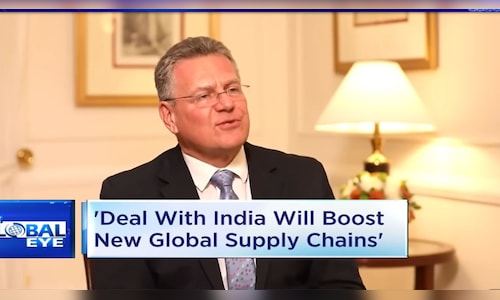
“India is in a prime position as the EU plans to treat it as an FTA partner, with privileged negotiations on market access for steel products,” EU Trade Commissioner Maroš Šefčovič stated exclusively to CNBC-TV18.
Šefčovič further mentioned that the EU would extend optimal support to Indian operators for CBAM compliance, while ensuring that no other country will be given better terms than India.
For Europe’s steelmakers, 2026 marks the year when CBAM becomes enforceable, making carbon intensity a factor in pricing and competitiveness. This mechanism aims to mitigate carbon leakage by imposing a levy on imported steel that reflects the carbon costs incurred by EU producers.
This situation arises during a crucial phase for Europe’s steel industry. The sector is financially burdened and undergoing a costly transition to low-carbon technology. Numerous green steel initiatives have faced delays due to high capital requirements, while demand from the automotive and construction industries remains weak.
Meanwhile, existing quotas and tariffs are set to expire in June 2026, with stricter regulations anticipated to drive up import prices amid ongoing oversupply from China.
Consequently, India’s steel exports to Europe are likely to decline once the EU’s carbon tax is implemented this month. As the world’s second-largest crude steel producer after China, India currently exports about two-thirds of its steel to Europe.
However, the India–EU FTA presents New Delhi with a rare opportunity. Brussels is granting preferential access for steel, offering assistance on CBAM compliance, and assuring that no nation will be treated more favorably.
This is significant as Indian exporters may need to absorb a 15–22% cost increase due to CBAM without a domestic carbon pricing mechanism. India is also seeking to lessen CBAM’s impact on steel, aluminum, cement, and fertilizers.
For the EU, the focus lies in securing compliant partners as its steel sector evolves. For India, the FTA transforms a policy challenge into a potential competitive edge in exports. India shipped 3.71 million tonnes of steel to the EU in 2024, from a total of 8.24 million tonnes exported.
The negotiations occur during a time when high US tariffs have disrupted global trade dynamics, prompting both India and the EU to diversify their markets and supply chains. Currently, the EU constitutes 17% of India’s exports, while India makes up around 9% of EU exports.
Trade between India and the EU reached $136.5 billion in the fiscal year ending March 2025.