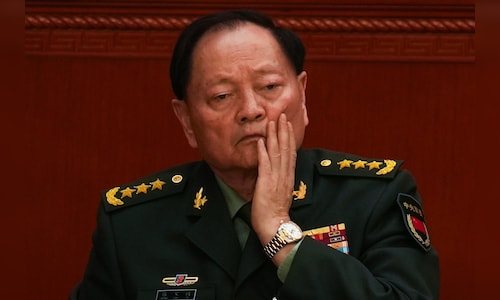
Gen. Zhang Youxia, the highest military official just below President Xi Jinping, is under scrutiny.
The Defense Ministry stated on Saturday that authorities are looking into Zhang, the senior of the two vice chairs of the influential Central Military Commission, along with Gen. Liu Zhenli, a member who led the military’s Joint Staff Department.
This development effectively disrupts nearly the entire commission chaired by Xi, leaving only one of its six members unaffected.
“Xi Jinping has executed one of the most substantial purges of China’s military leadership in the history of the People’s Republic,” remarked Neil Thomas, a fellow at the Asia Society Policy Institute’s Center for China Analysis.
The full ramifications of these changes for both the military and China as a whole remain uncertain. However, some analysts suggest that these adjustments may impact Beijing’s subsequent actions regarding Taiwan, the self-governed island claimed by China.
Here are key points to consider regarding the importance of Gen. Zhang’s removal.
Reasons Behind the Recent Military Purge
The Defense Ministry revealed the purging measures on Saturday without disclosing specific details about the alleged wrongdoing. The following day, the People’s Liberation Army Daily issued an editorial that did not enumerate the precise reasons but stated it was “for suspected serious violations of discipline and law,” reinforcing China’s commitment to combating corruption—an initiative Xi has championed since the onset of his presidency.
While rumors and some media reports regarding the changes have circulated, no official statements have been made.
“I do not believe that any evidence publicly released or selectively leaked by Chinese authorities would accurately reflect the core reason for Zhang’s removal,” explained K. Tristan Tang, a nonresident Vasey Fellow at Pacific Forum. “The crucial point is Xi Jinping’s decision to take action against Zhang; once an investigation is initiated, issues are likely to come to light.”
Analysts contend that these purges aim to reform the military and bolster loyalty to Xi. They are part of an expansive anti-corruption effort which has led to disciplinary actions against over 200,000 officials since Xi assumed power in 2012.
Prior to the dismissals of Zhang and Liu, the Communist Party expelled the other vice chair of the commission, He Weidong, in October, replacing him with Zhang Shengmin, who now stands as the sole commission member.
Since 2012, at least 17 Generals from the People’s Liberation Army (PLA) have been ousted from their military roles, including eight former high-ranking commission members, as per an analysis of military statements and state media reports by The Associated Press.
Impact of Top Military Changes on Taiwan
Some speculate that these removals could influence China’s stance on Taiwan, though the clarity of this potential impact is uncertain.
China views Taiwan as its territory and has threatened to seize control if necessary. Recently, China has heightened military pressure, even conducting extensive military exercises around Taiwan for two days following a significant U.S. arms sale to the island.
According to Thomas from the Asia Society Policy Institute, the recent purge “dilutes China’s immediate threat toward Taiwan, but strengthens it in the long term.”
The current state of disarray within the high command makes a military escalation against Taiwan riskier in the short term, but could entail a more loyal and capable military leadership in the longer run, he noted.
When asked if this situation might reinforce perceptions that China is unprepared for war, Tang from the Pacific Forum stated that it “does not fundamentally change that assessment.”
“That said,” he added, “I do not believe the PLA’s combat readiness has been severely disrupted.”
Uncertainty Surrounding the Military Commission’s Future
Following the recent changes, the military commission will function with only one of six members remaining active, led by Xi at the helm.
The PLA Daily editorial mentioned that following the actions against Zhang and Liu, the party aims to “promote the rejuvenation of the People’s Liberation Army and inject robust momentum into the construction of a powerful military force.”
However, it remains unclear whether the five vacant positions will be filled soon or if Xi will wait until 2027, when a new Communist Party Central Committee will be selected, which is responsible for appointing new military commission members.
Tang from the Pacific Forum doesn’t perceive any pressing need for Xi to fill these roles in the near term.
“Unless the aim is to create an internal counterbalance to Zhang Shengmin,” the only current member of the commission, he said.