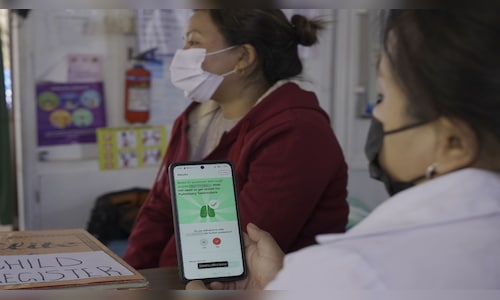
For the first time, the patient consents to resume treatment.
The patient, a man struggling with chronic alcoholism, had previously halted his tuberculosis (TB) treatment after leaving the district hospital. He refused medications and neglected follow-up appointments. “When I screened him using CAT and displayed the presumptive result—the red lungs—he finally agreed to restart treatment,” she reflects.
India represents nearly 25% of the global TB burden (1). In response, the Ministry of Health and Family Welfare and the Central TB Division (CTD) are enhancing the TB care continuum through the National TB Elimination Programme (NTEP). As part of this initiative, AI-driven solutions developed by Wadhwani AI are being integrated with Ni-kshay and woven into existing workflows to enhance detection, adherence, and outcomes.
Targeting High-Risk Areas
Vulnerability Mapping for TB (VMTB), created by Wadhwani AI and incorporated into the Ni-kshay portal and program planning processes, aids district and state teams in pinpointing high-risk areas and prioritizing active case finding. The tool employs geospatial analytics to link TB case locations with over 20 health and environmental factors, identifying regions with concentrated vulnerability. These insights enable health authorities to allocate resources more effectively and focus interventions where they are most crucial.
Extending Access in Remote Settings
In Meghalaya, where challenging terrains affect healthcare accessibility, reaching health facilities can require considerable time and planning. Villages are scattered across steep landscapes, and travel becomes more difficult during the monsoon. For CHO Ibaiada Syiemlieh, community outreach is a vital aspect of delivering care.
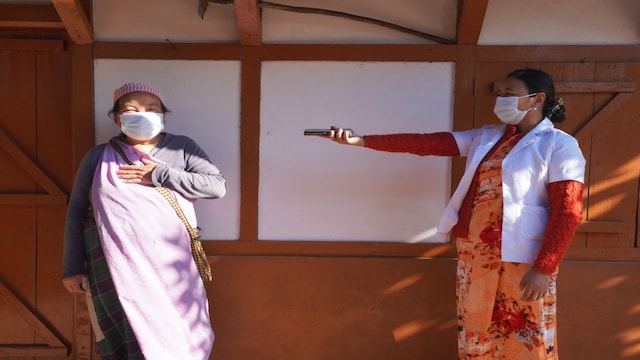
Community Health Officer (CHO) Ibaiada Syiemlieh conducts a tuberculosis screening using the Cough Against Tuberculosis (CAT) mobile application for Joylyone Lamare during a community visit in Shilliang Myntang village, West Jaintia Hills district, Meghalaya, India. CAT is an AI-powered, cough-sound–based screening tool used under the National Tuberculosis Elimination Programme (NTEP) to support early identification of individuals at risk and timely referral for diagnosis. Note: The participant briefly posed to visually document the screening process and correct use of the CAT application. Photo by Rohit Jain
She now screens individuals at their homes or during outreach visits using CATB, a mobile app developed by Wadhwani AI. It analyzes cough sound recordings and symptomatic data to evaluate presumptive pulmonary TB, allowing real-time decisions on whether a patient should be referred for further confirmatory testing. Designed for low-resource settings, CATB functions offline and integrates into the broader TB screening workflow at Ayushman Aarogya Mandir as well as at the community level.
This process prioritizes individuals needing referral for testing, often to facilities located some distance away. This alleviates both economic and logistical burdens on patients while optimizing the use of health system resources. To date, over 175,000 individuals have been screened using CATB, with more than 27,500 identified as presumptive TB cases across the regions where the application is in use.
“People comprehend better when they see the result displayed as a red or green screen!” she emphasizes. “They take it seriously.”
While early detection is crucial, ensuring patients continue their treatment is equally important.
Strengthening Treatment Adherence
In Maharashtra, senior treatment supervisor (STS) Vishal Mirajkar monitors patients via the Ni-kshay portal. If someone ceases to respond, he follows up through calls, visits, and coordination with local health workers.
Supporting this effort is the Prediction of Adverse TB Outcomes (PATO), a risk stratification system developed by Wadhwani AI in collaboration with CTD, MoHFW. It evaluates patient records at the initiation of treatment and identifies individuals at heightened risk of discontinuing treatment or facing adverse outcomes like mortality, enabling health workers to prioritize follow-up.
To date, over two million patient records have been analyzed through PATO, with more than 800,000 individuals recognized as high-risk. On the ground, this results in targeted actions including follow-up calls and personal visits to assist patients through their treatment.
“No patient should slip through the cracks,” Mirajkar asserts.
Improving Diagnosis and Lab Efficiency
Throughout the TB care continuum, initiatives are underway to enhance screening, diagnosis, treatment, and follow-up. In this context, accurate diagnosis, particularly for drug-resistant TB, remains vital. According to NTEP guidelines, all individuals with TB must undergo Line Probe Assay (LPA) testing. As demand for testing continues to increase, enhancing laboratory efficiency is a priority under NTEP.
In numerous labs, administrative duties are a significant aspect of daily workflows for lab technicians. A considerable amount of their time is spent on tasks such as manual interpretation of LPA results, paper-based data entry, and MIS reporting. To support them, the Line Probe Assay Automation, an AI solution crafted by Wadhwani AI, employs computer vision to automate reading and interpreting LPA test results, along with real-time result updates within the Ni-kshay portal. The solution is being gradually implemented and is currently integrated within the Ni-kshay portal to facilitate LPA automation across 97 NTEP-certified Culture and Drug Susceptibility Testing (CDST) and Intermediate Reference (IR) laboratories in both public and private sectors.
Collectively, these efforts enhance the TB care cascade from screening to treatment and follow-up by incorporating AI into routine public health systems. This empowers frontline workers to swiftly identify, prioritize, and support patients throughout their care journey.