
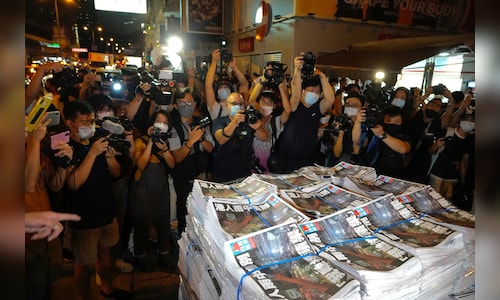
The decline can be attributed to the closure of the pro-democracy newspaper Apple Daily, increased restrictions on journalists, and a rise in self-censorship throughout the region. This deterioration of press freedom coincides with a wider crackdown on the city’s Western-style civil liberties since 2020, following the imposition of a national security law by Beijing aimed at suppressing dissent.
In December, Apple Daily founder Jimmy Lai was convicted under the security law and faces a potential life sentence. Hearings for him and other defendants began on Monday to seek reduced sentences.
His trial has attracted significant attention from foreign governments and political analysts as a gauge of media freedom in the former British colony, which reverted to Chinese sovereignty in 1997. The government maintains that his case is unrelated to press freedom.
Arrests, shutdowns and convictions
Once characterized by a vibrant media landscape, Hong Kong’s journalists frequently posed challenging questions to the government, despite their outlets often being pro-Beijing. News organizations regularly published stories critical of political figures.
However, the environment for reporters has drastically constricted since the enforcement of the security law, deemed essential for stability after mass anti-government protests in 2019.
Lai was among the first prominent individuals charged under this law in 2020. Within a year, authorities arrested several senior executives of Apple Daily, raiding the paper’s offices and freezing $2.3 million in assets, effectively leading to its shutdown in June 2021.
Similarly, the online news platform Stand News was forced to close in December 2021 due to arrests, police raids, and asset freezes. By 2022, Hong Kong had plummeted 68 places to 148th in the press freedom index compiled by Reporters Without Borders.
In 2024, two Stand News editors became the first journalists since 1997 to be convicted of conspiracy to publish seditious articles under a colonial-era law.
In December, Lai was found guilty of conspiring to collaborate with foreign entities and conspiracy to publish seditious articles. Six executives from Apple Daily involved in the same case pleaded guilty, admitting to conspiring with Lai to seek sanctions or engage in other hostile actions against Hong Kong or China.
Red lines and censorship
According to Francis Lee, a journalism and communication professor at the Chinese University of Hong Kong, the cases of Apple Daily and Stand News indicate that many past journalistic practices are now prohibited. The Stand News case illustrated that highly critical commentary may now be interpreted as seditious, he noted. Lai’s case involved accusations of advocating for foreign sanctions.
“Previously, there was perhaps some allowance for advocacy journalism within the legal framework,” he reflected, referencing the period before the security law was enacted. “That is no longer the case.”
Self-censorship has become more prevalent, not solely due to political pressures. Lee highlighted that mainstream outlets are under increasing pressure not to offend major revenue generators like advertisers amid a challenging business climate.
Many large corporations in the city prioritize their relationships with the vast mainland Chinese market and the government.
Finding sources for interviews has also become increasingly difficult. “In today’s Hong Kong, when certain topics can’t be covered, it’s not only due to media outlets practicing self-censorship,” Lee pointed out. “There’s a broader social phenomenon where no one is willing to speak.”
Numerous opposition politicians and key activists have been imprisoned under the security law. Many civil society organizations have shut down, and even residents are now more hesitant to communicate with journalists due to perceived risks.
Selina Cheng, chairperson of the Hong Kong Journalists Association, stated that stories considered politically sensitive or potentially challenging to authorities are not easily published. There’s a heightened concern about including responses from the government and pro-China groups for the sake of balance, she noted.
“Journalism in Hong Kong now carries the constant concern of potential repercussions for those involved,” commented Cheng.
Aftermath of deadly fire highlights the changes
A tragic fire that claimed at least 161 lives in an apartment building in late November illustrated some shifts in the media landscape.
Following the blaze on Nov. 26, reporters, including those from newer online platforms, mobilized to cover Hong Kong’s deadliest fire in decades. They interviewed affected residents, examined the scaffolding netting that officials claimed had contributed to the fire’s rapid spread, and reported on governmental oversight issues.
Cheng commended the media coverage of the aftermath. Nevertheless, warnings and arrests ensued.
Beijing’s national security branch summoned representatives from various foreign news outlets, including The Associated Press, on Dec. 6. The Office for Safeguarding National Security accused some foreign media of spreading false information and tarnishing the government’s relief efforts post-fire, as well as criticizing the legislative election.
Following arrests of non-journalists for posting allegedly seditious content online or organizing petitions, public discourse became quieter, leaving reporters with fewer sources, Lee observed.
A planned press conference regarding the fire, organized by former pro-democracy district councillors, was canceled. Bruce Liu, one of the organizers, was called in by police for a meeting the same day. An investigative piece regarding maintenance work by a pro-Beijing newspaper has vanished from its website.
Ellie Yuen, who went viral for a social media post questioning regulatory oversight, stated she ceased posting about the fire for “obvious reasons,” without further elaboration.
Cheng expressed concern over what she described as the “more covert intimidation of individuals attempting to speak out.”
“If this trend continues, it will become increasingly difficult for the public to understand what they’re missing,” she cautioned.
In response to AP’s inquiries via email, the government vehemently denounced efforts to exploit the fire as a pretext for unfounded accusations against the administration.
“Human rights and the freedoms of Hong Kong residents have always been safeguarded by the constitution and the Basic Law,” it asserted.
Challenges extend beyond reporting
In addition to reporting restrictions, Cheng’s union previously voiced concerns regarding journalists facing disproportionate tax audits and harassment through anonymous communications. The Inland Revenue Department has maintained that a taxpayer’s background does not influence its reviews.
Cheng has filed a lawsuit against her former employer, The Wall Street Journal, for allegedly terminating her employment due to her union activities.
Both Cheng and Lee indicated that journalists are still adapting to survive within this increasingly constricted landscape.
In October, Cheng’s association reported a slight rebound in journalists’ ratings concerning the city’s press freedom index.
“The current situation is far from the previous state of freedom,” Lee remarked. “Self-censorship is pervasive throughout society. Yet, some media outlets are still discovering ways to navigate this environment.”


